- English
- French
- German
- Portuguese
- Spanish
- Russian
- Japanese
- Korean
- Arabic
- Greek
- German
- Turkish
- Italian
- Danish
- Romanian
- Indonesian
- Czech
- Afrikaans
- Swedish
- Polish
- Basque
- Catalan
- Esperanto
- Hindi
- Lao
- Albanian
- Amharic
- Armenian
- Azerbaijani
- Belarusian
- Bengali
- Bosnian
- Bulgarian
- Cebuano
- Chichewa
- Corsican
- Croatian
- Dutch
- Estonian
- Filipino
- Finnish
- Frisian
- Galician
- Georgian
- Gujarati
- Haitian
- Hausa
- Hawaiian
- Hebrew
- Hmong
- Hungarian
- Icelandic
- Igbo
- Javanese
- Kannada
- Kazakh
- Khmer
- Kurdish
- Kyrgyz
- Latin
- Latvian
- Lithuanian
- Luxembou..
- Macedonian
- Malagasy
- Malay
- Malayalam
- Maltese
- Maori
- Marathi
- Mongolian
- Burmese
- Nepali
- Norwegian
- Pashto
- Persian
- Punjabi
- Serbian
- Sesotho
- Sinhala
- Slovak
- Slovenian
- Somali
- Samoan
- Scots Gaelic
- Shona
- Sindhi
- Sundanese
- Swahili
- Tajik
- Tamil
- Telugu
- Thai
- Ukrainian
- Urdu
- Uzbek
- Vietnamese
- Welsh
- Xhosa
- Yiddish
- Yoruba
- Zulu
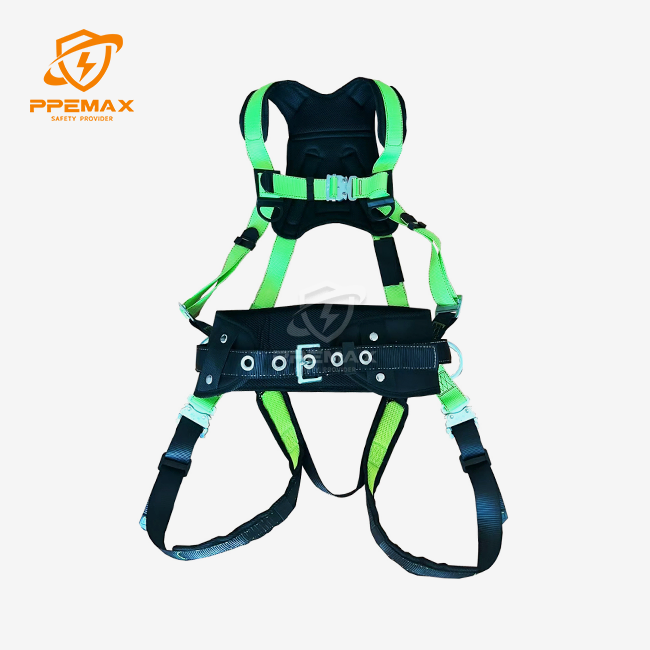
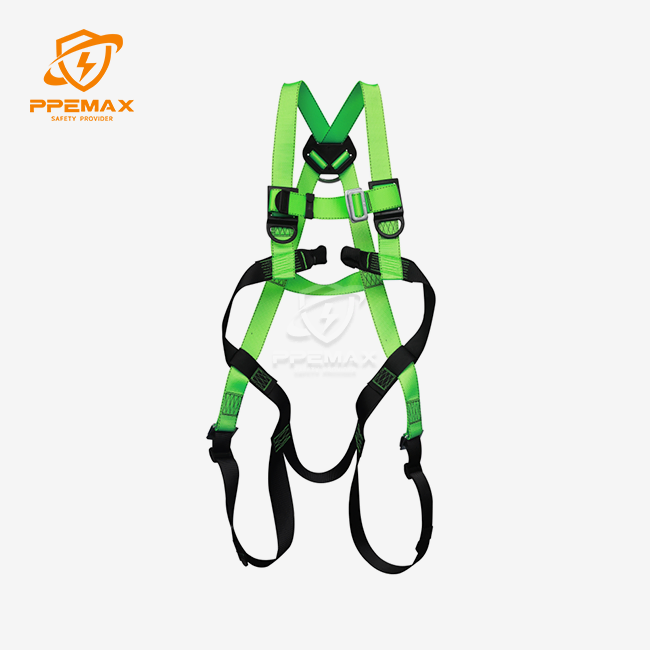
2D-Ring Full Body Safety Harness
Webbing: Polyester webbing with 45 mm
Attachment points: 1 dorsal D-ring and 1 frontal D-ring
Buckles: Pass-Thru chest and legs
Adjustments: Adjustable shoulder, chest and leg straps
2D-Ring Full Body Safety Harness – Dorsal & Sternal D-Ring Design
Xi'An PPE MAX Co., Ltd has made worker safety gear since 1956. The 2D-Ring Full Body Safety Harness is built with 45 mm high-tenacity polyester webbing. It has two D-ring attachment points: one dorsal and one sternal. Chest and leg buckles are Pass-Thru style. The harness meets ANSI Z359.11-2014. It also covers CSA Z259.10 and EN 361:2002. Shoulder straps adjust to fit many body sizes. Chest and leg straps adjust too. PPE MAX ships every unit with documented pre-shipment quality control.

What Is This Product?
Two separate D-ring attachment points define This product. This is a full-body fall protection system. One D-ring sits on the back (dorsal). The other sits on the chest or front (sternal).
The dorsal D-ring handles fall arrest. A self-retracting lifeline or shock-absorbing lanyard clips to it. The thighs and pelvis then take the fall forces. That load also reaches the chest and shoulders. Maximum arrest force stays at or below 8 kN (ANSI) or 6 kN (EN).
The sternal D-ring handles work positioning, ladder climbing, and rescue operations. Together, the two attachment points let workers transition between fall restriction and vertical ascent without swapping equipment — a practical advantage on job sites that require both functions in a single shift.

Standard Specifications
| Parameter | Detail |
|---|---|
| Webbing Material | High-tenacity polyester |
| Webbing Width | 45 mm |
| Attachment Points | 1 Dorsal D-ring + 1 Sternal D-ring |
| Buckle Type | Pass-Thru chest and leg buckles |
| Adjustments | Shoulder, chest, and leg straps |
| Lanyard Parks | 2 |
| Max. Arrest Force | ≤ 8 kN (ANSI) / ≤ 6 kN (EN) |
| Static Strength Test | 15 kN sustained for 3 minutes |
| Weight Capacity | 130–310 lbs (59–140 kg) per ANSI Z359.11 |
| Compliance Standards | ANSI Z359.11-2014, CSA Z259.10, EN 361:2002 |
Features
- 45 mm polyester webbing has a minimum tensile strength of 22.2 kN / 5,000 lbs. The webbing stands up to UV. It also stands up to abrasion and mold
- Two forged D-rings: zinc-plated alloy steel with a heat treatment. Proof-loaded to 16 kN (3,600 lbs)
- Pass-Thru buckles on chest and legs — quick to close and secure under load
- Dual-color webbing scheme: shoulder and leg straps are color-coded for fast, correct donning
- Box-X stitching at all stress points — computerized stitch pattern to resist seam failure under dynamic loads
- 2 lanyard parks: clip lanyards here to keep them out of the way whenever they are not in use
- Fully adjustable: the shoulder straps move on their own, and so do the chest and leg straps. The fit then follows the body
How the Dual-Ring Layout Works in Practice
Crews run into the same snag again and again. Two rings fix it. A lot of jobs call for fall arrest and work positioning at the same time. With one ring on the harness, you stop midway and switch gear. Here both options stay open, so the job keeps moving.
Fall arrest runs off the dorsal D-ring. It connects to rigid rail systems and self-retracting lifelines. Climbing and positioning work goes through the sternal D-ring. That one links to cable grabs on vertical ladders. Hardware is forged steel with zinc plating. Corrosion does not beat it outdoors or on industrial sites. Sun and damp weather leave the 45 mm polyester webbing alone too.
Applications
Tower Climbing & Telecommunications: Going up, clip the front D-ring onto the vertical ladder safety cables. Keep the back D-ring free for twin-leg lanyards. You need that one once you move onto structural work at height.
Confined Space Entry & Rescue: Lowering and lifting in a controlled vertical line is what the sternal D-ring of a 2D-Ring Full Body Safety Harness lets you do. An unconscious worker stays upright through extraction when the dual-ring setup is used. Injury risk goes down as a result.
Construction & Scaffolding: Your main fall arrest point on suspended platforms is the back D-ring. Work-positioning lanyards should be paired with the front D-ring. Both hands then stay free for the job.

Certifications
This harness is tested and produced to meet:
- ANSI Z359.11-2014: the US standard that covers full-body harnesses
- CSA Z259.10: Canada's fall protection standard
- EN 361:2002: European personal fall arrest standard
Every piece of hardware gets proof-loaded. Each one is then checked with dynamic drop tests, plus static strength holds of 15 kN that last 3 minutes.
Customization for 2D-Ring Full Body Safety Harness
A different webbing color is something you can choose. Sizing and labeling can be adjusted too. Tell us what you need before you order.
Packing
We pack products to keep webbing and hardware safe in transit. Poly bags with hang tags and export cartons come standard. Want custom packaging with your brand label? Just ask.
After-Sales Service
- Pre-shipment quality inspection documentation provided with each order
- Product use and inspection guidance included
- Replacement parts support available
- After-sale inquiries acknowledged within 24 business hours
About PPE MAX
Xi'An PPE MAX Co., Ltd has made safety equipment since 1956. Fall protection products go to construction, tower climbing, rescue, and industrial work. Every harness comes as a 2D-Ring Full Body Safety Harness with written quality control records. You can visit the factory. Contact us ahead of time to set up a tour of the production floor and testing area.


FAQ
Q: What is the difference between the back and front D-rings?
A: Fall arrest is the job of the dorsal (back) D-ring. Lifelines clip in there. That ring is rated to soak up fall energy within the limits set by the applicable standard. For fall restriction, ladder climbing, work positioning, or rescue, the sternal (front/chest) D-ring is the one to use. Never treat the front ring as your main fall arrest point. The only exception is a product specifically rated for that use.
Q: What is the weight capacity?
A: The standard rated range is 130 to 310 lbs (59 to 140 kg) under ANSI Z359.11. Any clothing and tools you carry on your body count toward that weight.
Q: How often should a harness be inspected?
A: Inspect before every shift. A documented inspection by a qualified competent person is required at least once every 6 to 12 months, as referenced by OSHA guidelines.
Q: Can this harness be used for prolonged suspension work?
A: For short suspension work, such as a rescue lift, the sternal D-ring is the one to use. Long stretches on ropes call for something else. A harness with extra waist and side D-rings tends to give better lumbar support, and comfort holds up better over time.
Q: When must a harness be retired?
A: Retire the harness as soon as it has caught a fall, even if it looks fine. Tiny cracks can hide inside the webbing. Bent hardware is easy to miss too. Cut up any harness you take out of service so nobody uses it again.
Q: How can I tell the stitching still holds?
A: Look at the contrast stitching thread at the stress points. If that thread is cut or gone, the section loses its strength. Take the harness out of service.
Contact Us
To request a quote or ask about the 2D-Ring Full Body Safety Harness, email bettybing@ppemax.com. We respond within 24 business hours.
Learn about our latest products and discounts through SMS or email