- English
- French
- German
- Portuguese
- Spanish
- Russian
- Japanese
- Korean
- Arabic
- Greek
- German
- Turkish
- Italian
- Danish
- Romanian
- Indonesian
- Czech
- Afrikaans
- Swedish
- Polish
- Basque
- Catalan
- Esperanto
- Hindi
- Lao
- Albanian
- Amharic
- Armenian
- Azerbaijani
- Belarusian
- Bengali
- Bosnian
- Bulgarian
- Cebuano
- Chichewa
- Corsican
- Croatian
- Dutch
- Estonian
- Filipino
- Finnish
- Frisian
- Galician
- Georgian
- Gujarati
- Haitian
- Hausa
- Hawaiian
- Hebrew
- Hmong
- Hungarian
- Icelandic
- Igbo
- Javanese
- Kannada
- Kazakh
- Khmer
- Kurdish
- Kyrgyz
- Latin
- Latvian
- Lithuanian
- Luxembou..
- Macedonian
- Malagasy
- Malay
- Malayalam
- Maltese
- Maori
- Marathi
- Mongolian
- Burmese
- Nepali
- Norwegian
- Pashto
- Persian
- Punjabi
- Serbian
- Sesotho
- Sinhala
- Slovak
- Slovenian
- Somali
- Samoan
- Scots Gaelic
- Shona
- Sindhi
- Sundanese
- Swahili
- Tajik
- Tamil
- Telugu
- Thai
- Ukrainian
- Urdu
- Uzbek
- Vietnamese
- Welsh
- Xhosa
- Yiddish
- Yoruba
- Zulu
What Certifications Ensure Insulating Gloves Are Safe?
Insulating gloves are the last line of defence against getting an electric shock. They protect people who work with live wires every day. These insulating gloves are safe because they have been certified by ASTM D120 (North America), IEC 60903 (international standard), and EN 60903 (European compliance). These approvals show that insulating gloves meet strict standards for electrical protection, mechanical sturdiness, and testing methods that are specific to voltage. If insulating gloves don't have the right approval marks, they might not have proven insulating strength, which puts workers in dangerous situations when they are working with live electricity.
Understanding Electrical Insulation Protection and Why Certification Matters
Standard work gloves can't protect you from the dangers that come with working with electricity. When workers are working on power lines, installing telecommunications equipment, or fixing industrial electrical systems, rubber insulation gloves protect them from voltage levels that could be fatal.
The materials used to make these barriers—usually natural rubber latex or man-made compounds—must have very good insulating qualities. This means that they don't let electricity flow through them, even when thousands of volts are applied to them during tests. But the quality of the material doesn't ensure safety by itself.
The Hidden Dangers of Uncertified Products
Buying electrical safety gloves that aren't approved is a very risky thing to do. Without approval from a third party, producers could use low-quality products, uneven production methods, or poor quality control. A tiny flaw or unevenness in the material can make a way for electricity to flow, which can hurt or kill someone. Aside from the emotional cost, companies that hurt workers using non-compliant tools can be sued, fined, and have their reputations hurt.
How Certification Protects Your Workforce
Certification is an outside check that every batch of a product meets safety standards that have already been set. In testing labs, electrical stress far exceeds the maximum voltage of the gloves, which is used to model ageing and check for physical stability. This strict process finds problems with goods before they get to your workplaces. When you buy approved rubber-insulated gloves, you get written proof that they meet safety standards, which is needed for insurance purposes, regulatory checks, and safety reports.
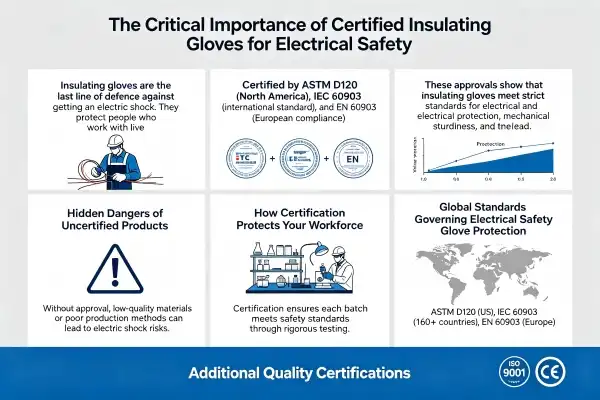
Global Standards Governing Electrical Safety Glove Protection
Multiple organizations worldwide establish the technical requirements that define safe electrical protective equipment. Understanding these standards helps procurement teams make informed decisions and ensure global compliance across diverse operational regions.
ASTM D120: The North American Benchmark
ASTM D120 is still the most important standard in the US, and it's what OSHA uses to make sure that workers follow the rules in 29 CFR 1910.137 for insulating gloves. This standard lists six voltage classes (00 to 4), the qualities of the material, the rates of tests, and the requirements for marking insulating gloves. As a safety measure, manufacturers must show that their insulating gloves can handle proof test voltages that are much higher than the maximum use voltages.
The standard also defines two types of materials: Type I is natural rubber, which is more flexible and sensitive to touch, and Type II is manufactured substances, which are more resistant to damage from ozone and ultraviolet light. Both types go through the same electronic tests, but they might work differently in some environments.
IEC 60903 and EN 60903: International Harmonization
Over 160 countries have agreed to use IEC 60903 as their worldwide standard. This makes it easier to buy things around the world without lowering safety standards. The European standard EN 60903 directly uses IEC rules, which makes sure that all European markets are compliant. When it comes to voltage classifications and testing methods, these standards are very similar to ASTM D120. However, there are some small changes in how things are marked and how often they need to be inspected.
This international harmonisation is good for global supply lines and businesses that work with many countries. Gloves that are approved to IEC 60903 meet standards in Asia, Africa, the Middle East, and the Americas. This makes buying easier for businesses that do business in more than one area. Procurement teams can define IEC compliance to make sure that security standards are the same everywhere the system is used.
Additional Quality Certifications
Beyond electrical standards, ISO 9001 quality management certification indicates manufacturers maintain consistent production processes. Regional safety marks—such as CE marking for European markets—demonstrate broader regulatory compliance. Some manufacturers also pursue voluntary third-party certifications that verify environmental management systems, ethical sourcing, or specialized performance characteristics.
Rigorous Testing Protocols That Validate Glove Safety
Certification isn't simply a paperwork exercise—it requires extensive laboratory testing and ongoing quality surveillance. Understanding these procedures helps procurement professionals evaluate supplier credibility and product reliability.
Electrical Dielectric Testing
Every glove is put through a dielectric test, in which water is used as a carrier and high voltage is applied to the glove. The test voltage is much higher than the glove's highest use rating. For example, a Class 00 glove that is rated for 500V AC must be able to handle 2,500V during proof testing. Technicians keep an eye out for any current leaks that could mean the insulation is breaking down. Gloves that pass show that they can keep workers safe even when there are power spikes or other unexpected situations.
This testing happens three times: when the gloves are first certified, when random samples are taken from production batches, and every six months after they are put to use. The methodical approach finds problems with the way the product was made, wear and tear on the materials, and damage from use in the field before they happen on the job site.
Physical and Mechanical Evaluation
Electrical properties alone don't ensure workplace protection. Gloves must withstand the mechanical stresses of daily use—cuts from sharp edges, punctures from wire ends, tears from rough surfaces, and abrasion from repeated handling. Testing protocols evaluate tensile strength, elongation, puncture resistance, and ozone resistance.
Flexibility testing confirms that insulating gloves maintain dexterity across their temperature range. Workers need sufficient tactile sensitivity to manipulate small components, operate tools, and maintain situational awareness. Insulating gloves that become stiff in cold conditions or overly soft in heat fail to provide practical protection, regardless of their electrical properties.
Visual Inspection Requirements
Standards mandate detailed visual inspection protocols both in testing laboratories and before each use. Inspectors examine gloves for embedded foreign objects, surface irregularities, texture changes indicating material degradation, and physical damage. Color changes, particularly near high-stress areas, may signal UV damage or chemical exposure. Proper inspection training helps workers identify gloves requiring removal from service before
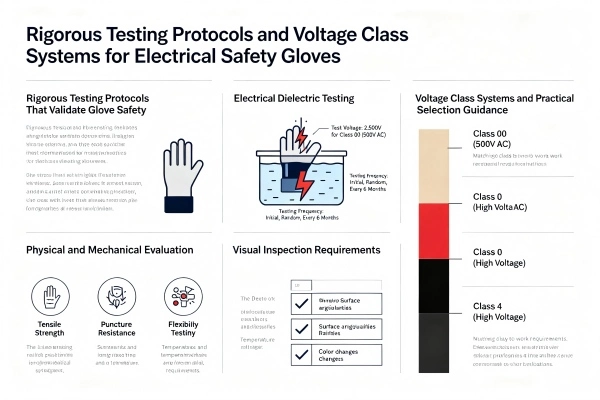
electrical testing reveals problems.
Voltage Class Systems and Practical Selection Guidance
Certification standards divide electrical protective gloves into distinct classes based on maximum use voltage. Proper class selection directly impacts worker safety and operational efficiency.
Understanding the Class 00 Through Class 4 System
The classification system progresses from Class 00 (lowest voltage) through Class 4 (highest voltage). Class 00 gloves protect workers handling circuits up to 500V AC, making them appropriate for residential electrical work, low-voltage control circuits, and telecommunications systems. At PPE MAX, our Class 00 insulating gloves meet both ASTM D120 and IEC 60903 standards, featuring a proof test rating of 2,500V—five times the maximum use voltage.
Moving up the scale, Class 0 gloves handle up to 1,000V AC, suitable for industrial maintenance and utility distribution work. Class 1 and Class 2 gloves address medium-voltage applications common in substations and transmission systems. Classes 3 and 4 serve high-voltage utility work where specialized training and equipment are mandatory.
Matching Glove Class to Work Requirements
Proper selection requires accurate voltage assessment of the work environment. Many organizations default to higher-class gloves, assuming more protection equals better safety. However, higher-class gloves feature thicker walls that reduce dexterity and increase hand fatigue. Workers performing intricate tasks with unnecessarily heavy gloves may remove them prematurely, negating their protective value.
The optimal approach involves conducting a thorough hazard assessment that identifies maximum voltage exposure, required manual dexterity, environmental conditions, and task duration. This analysis guides class selection that balances protection with practical usability.
Color Coding and Quick Identification
Standardized color coding enables rapid visual verification of glove class. Class 00 gloves typically feature beige or tan coloring, though manufacturers may use red or black depending on material composition and regional preferences. Our Class 00 models at PPE MAX are available in red and black, clearly marked with voltage class, size, and test date information directly on each glove.
This visual system reduces the risk of workers inadvertently using underrated gloves for higher-voltage tasks. Properly implemented color coding becomes part of your safety culture, enabling supervisors and coworkers to spot potential mistakes before work begins.
Strategic Procurement Approaches for Certified Electrical Safety Equipment
Sourcing decisions around electrical protective equipment require careful evaluation beyond simple price comparison. The long-term value of certified products far exceeds any initial cost savings from uncertified alternatives.
Evaluating Manufacturer Credentials
Reputable manufacturers maintain transparent certification documentation, operate accredited testing laboratories, and submit to regular third-party audits. At PPE MAX, our manufacturing heritage dates to 1956, establishing us as the largest PPE producer in Northwest China with distribution across 134 countries. This longevity reflects consistent quality and ongoing investment in safety technology.
When evaluating potential suppliers, request copies of current certification documents, inquire about testing frequencies, and verify accreditation of testing laboratories. Legitimate manufacturers readily provide this information, while those offering suspiciously low prices often cannot produce valid documentation.
Total Cost of Ownership Considerations
The initial purchase price represents only one component of true ownership costs. Certified gloves from established manufacturers typically offer longer service life, reducing replacement frequency. Their consistent quality minimizes the risk of failed electrical testing, which removes gloves from inventory and disrupts work schedules. Most significantly, they reduce the likelihood of injuries that generate workers' compensation claims, legal expenses, and project delays.
Organizations should calculate the total cost, including purchase price, testing expenses, expected lifespan, and risk mitigation value. This comprehensive analysis usually favors certified products from reputable manufacturers despite higher upfront costs.
Storage and Maintenance Protocols
Proper care extends glove life and maintains protective properties between testing intervals. Gloves require storage in cool, dark, dry locations away from ozone sources (electric motors, welders), direct sunlight, and chemical exposure. Many organizations use dedicated storage cabinets with climate control to optimize conditions.
Our Class 00 insulating gloves at PPE MAX come packaged in individual boxes (one pair per box, 20 pairs per carton) that protect them during storage and transportation. The 11-inch and 14-inch length options accommodate different arm coverage requirements and clothing configurations.
Building Supplier Relationships
Long-term partnerships with certified manufacturers provide advantages beyond product quality. Established relationships enable customization for specific operational needs, priority fulfillment during supply disruptions, technical support for unusual applications, and training resources for safety personnel. Manufacturers invested in customer success offer consultation on voltage classification, usage guidelines, and compliance documentation.
PPE MAX Class 00 Solutions for Low-Voltage Applications
Our Class 00 rubber-insulated gloves are the result of more than 70 years of experience making safety gear. There are special problems that electricians in telecommunications, energy billing, industrial control systems, and domestic electrical services have to deal with.
Our Class 00 line was made to provide important safety while also being easy to use. The comfortable design keeps your hands from getting tired after long periods of use, and buying teams like how cheap it is and how well it meets the requirements for a big fleet approval.
Material choice has a big effect on performance. Our high-quality natural rubber latex structure is great for controlling measuring tools, circuit breakers, and wire connections because it is flexible and pleasant to the touch. To do their jobs, workers need to be able to move their hands quickly and easily. The average thickness of 0.5 mm covers them.
In harsh settings, environmental defence makes gloves last longer. Ozone breakdown and UV rays hurt other rubber compounds, but ours stays strong. These gloves will keep your hands safe for as long as they're supposed to, even in hot deserts, humid coastal areas, and factories with ozone-making machines.
Because they can handle 500V AC (750V DC), Class 00 gloves are great for low-voltage conditions where too much safety would slow down work. The 2,500V proof test rating gives five times more safety because of voltage spikes, the effects of ageing, and the need for theoretical ratings to take into account how things change in the real world.
We have sizes 8–11 so that they can fit a wide range of hands. Gloves that are too big make it hard to move your fingers and catch on things, while gloves that are too small cut off blood flow and tear when you put them on. With our method to size, buying teams can protect whole workforces.
11- or 14-inch lengths work for a range of clothing methods and protection needs. The extra 14-inch length covers the wrists and keeps gaps to a minimum while working above or reaching into equipment boxes. Class marks, size, and test dates are clearly shown on each glove for compliance papers and checking before use.
We ship all over the world. The 54.5 x 35 x 42.5 cm box (6.5 kg for 20 pairs) saves money on shipping costs and keeps goods safe while they're being shipped internationally. Supply chain reliability is just as important as product quality for businesses that keep track of their stock across multiple locations.
Conclusion
Certification stands as the essential verification that insulating gloves provide genuine electrical protection rather than false security. ASTM D120 and IEC 60903 standards establish the testing rigor, material requirements, and quality systems that separate life-saving equipment from dangerous imitations. Procurement professionals who prioritize certified products protect their workers, ensure regulatory compliance, and reduce organizational liability. The investment in properly certified, voltage-appropriate electrical safety gloves returns value through injury prevention, extended product life, and operational confidence. Organizations committed to electrical safety make certification status a non-negotiable requirement in their sourcing decisions.
FAQ
1. How often do certified insulating gloves require retesting?
OSHA regulations aligned with ASTM F496 mandate electrical retesting every six months once gloves enter active service. Gloves remaining in original packaging may wait up to 12 months before initial testing, but the six-month cycle begins immediately upon first issue. This frequency accounts for material aging, environmental exposure, and mechanical wear that gradually degrade dielectric properties. Organizations must maintain detailed testing records documenting test dates, voltage levels, and pass/fail results for regulatory compliance and liability protection.
2. Can I identify certified gloves through visual inspection alone?
Legitimate certified gloves display permanent markings including voltage class, size, manufacturer identification, and latest test date. However, markings can be counterfeited. Procurement teams should request certification documentation, including test reports from accredited laboratories, verify manufacturer credentials, and confirm that pricing aligns with certified product costs. Suspiciously inexpensive gloves lacking detailed documentation likely lack authentic certification regardless of their markings.
Partner With PPE MAX for Certified Electrical Protection Solutions
Electrical safety demands more than equipment—it requires partnership with experienced insulating gloves manufacturers committed to your workforce protection. PPE MAX brings 68 years of PPE manufacturing expertise to every product we deliver across 134 countries. Our Class 00 insulating gloves provide ASTM D120 and IEC 60903-certified protection backed by rigorous testing protocols and quality systems refined over decades.
We understand that procurement teams need reliable suppliers offering competitive bulk pricing, customization capabilities, and responsive technical support. Whether you're outfitting telecommunications crews, industrial maintenance teams, or utility workers, our solutions balance certified safety with practical usability. Connect with our team at marketing@ppemax.com to discuss your specific voltage protection requirements, request detailed product specifications, or arrange a sample evaluation. We're ready to support your electrical safety program with certified products, expert guidance, and the manufacturing capacity to meet enterprise-scale requirements.
References
1. American Society for Testing and Materials. "ASTM D120-19: Standard Specification for Rubber Insulating Gloves." ASTM International, 2019.
2. International Electrotechnical Commission. "IEC 60903:2002+AMD1:2021: Live working - Electrical insulating gloves." IEC Standards, 2021.
3. Occupational Safety and Health Administration. "29 CFR 1910.137: Electrical Protective Equipment." U.S. Department of Labor, Federal Register.
4. National Fire Protection Association. "NFPA 70E: Standard for Electrical Safety in the Workplace, 2021 Edition." NFPA Publications, 2020.
5. American Society for Testing and Materials. "ASTM F496-20: Standard Specification for In-Service Care of Insulating Gloves and Sleeves." ASTM International, 2020.
6. European Committee for Electrotechnical Standardization. "EN 60903:2003: Live working - Electrical insulating gloves." CENELEC Standards, 2003.
Learn about our latest products and discounts through SMS or email