- English
- French
- German
- Portuguese
- Spanish
- Russian
- Japanese
- Korean
- Arabic
- Greek
- German
- Turkish
- Italian
- Danish
- Romanian
- Indonesian
- Czech
- Afrikaans
- Swedish
- Polish
- Basque
- Catalan
- Esperanto
- Hindi
- Lao
- Albanian
- Amharic
- Armenian
- Azerbaijani
- Belarusian
- Bengali
- Bosnian
- Bulgarian
- Cebuano
- Chichewa
- Corsican
- Croatian
- Dutch
- Estonian
- Filipino
- Finnish
- Frisian
- Galician
- Georgian
- Gujarati
- Haitian
- Hausa
- Hawaiian
- Hebrew
- Hmong
- Hungarian
- Icelandic
- Igbo
- Javanese
- Kannada
- Kazakh
- Khmer
- Kurdish
- Kyrgyz
- Latin
- Latvian
- Lithuanian
- Luxembou..
- Macedonian
- Malagasy
- Malay
- Malayalam
- Maltese
- Maori
- Marathi
- Mongolian
- Burmese
- Nepali
- Norwegian
- Pashto
- Persian
- Punjabi
- Serbian
- Sesotho
- Sinhala
- Slovak
- Slovenian
- Somali
- Samoan
- Scots Gaelic
- Shona
- Sindhi
- Sundanese
- Swahili
- Tajik
- Tamil
- Telugu
- Thai
- Ukrainian
- Urdu
- Uzbek
- Vietnamese
- Welsh
- Xhosa
- Yiddish
- Yoruba
- Zulu
Welding Face Shield Design Innovations: Lightweight & Venting
To handle the ongoing problems of operator weariness and comfort during lengthy welding operations, the modern Welding Face Shield design has greatly changed. Modern, creative solutions concentrate on two important areas: lowering weight through advanced material engineering and improving air systems to keep heat from building up and freezing up. In industrial settings, these design changes have a direct effect on worker happiness, safety compliance, and efficiency. As purchasing managers and safety engineers look at different types of safety gear, they need to know about these new technological developments in order to make smart buying choices that balance performance, comfort, and long-term costs.
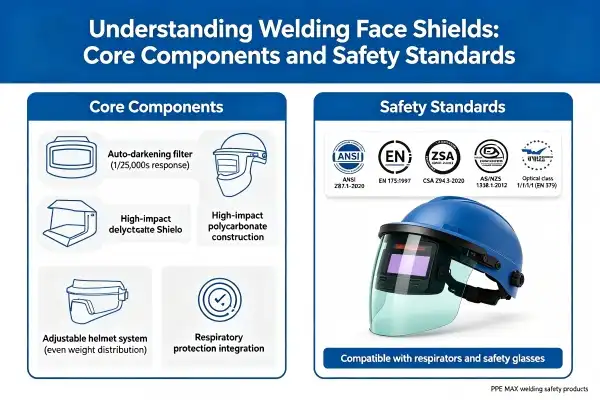
Understanding Welding Face Shields: Core Components and Safety Standards
Welding Face Shield technology is an advanced way to protect workers because it combines many safety features into a single system that works well together. Face shields, on the other hand, cover more area than regular welding helmets while still being lighter and giving you better peripheral vision.
Essential Protective Components
There are a few important parts in modern welding security systems that all work together to make sure everyone is safe. The main lens assembly has auto-darkening filter technology that can respond as quickly as 1/25,000th of a second. This keeps the visual clarity while protecting against UV and infrared radiation. The high-impact-resistant polycarbonate construction protects against sparks and other debris, and the changeable helmet systems spread the weight evenly across the user's head and neck. As businesses become more aware of the need for full protection against both eye dangers and airborne contaminants, the ability to integrate with respiratory protection systems has grown in importance. The welding safety products from PPE MAX can be used with respirators and safety glasses, so they can be easily combined to meet all of your safety needs.
International Safety Compliance Standards
Following safety certifications is an important part of buying industrial welding protection that can't be skipped. ANSI Z87.1-2020, EN 175:1997, CSA Z94.3-2020, and AS/NZS 1338.1:2012 are some of the most important standards that set base requirements for performance in areas like visual clarity, impact resistance, and switching speed. These licenses make sure that safety gear meets strict testing standards in all foreign markets. The optical class rate system, especially the 1/1/1/1 classification according to EN 379 standards, makes sure that there is no blurring, distortion, or uneven shading that could affect the accuracy of the welding or the safety of the user.
Lightweight Welding Face Shield Innovations: Breaking Performance Barriers
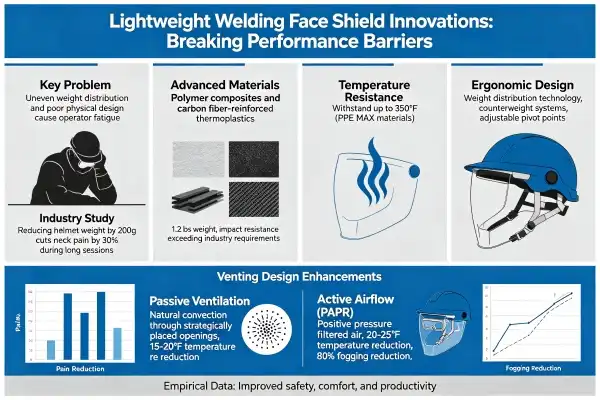
Due to uneven weight distribution and bad physical design, traditional welding protection often makes the person wearing it very tired. According to a study from the welding industry, lowering the weight of a helmet by just 200 grams can cut neck pain by up to 30% during long welding sessions.
Advanced Material Engineering Solutions
Protection gear like Welding Face Shield that stays strong while weighing a lot less has been made possible by revolutionary advances in material science. Modern materials like advanced polymer composites and carbon fiber-reinforced thermoplastics are stronger and lighter than older ones. With these new technologies, companies can make safety systems that weigh as little as 1.2 pounds but still have impact resistance scores that are higher than what the industry needs. These high-tech materials' temperature qualities also help keep operators comfortable by stopping heat from leaving the system from outside sources. High-quality nylon and special thermoplastic blends are used by PPE MAX. These can withstand temperatures up to 350°F and keep their shape in tough industrial settings.
Ergonomic Design Improvements
Weight distribution technology has grown past simple padding systems to include complex support systems that spread the load evenly over many touch points. Modern equipment has counterweight systems and movable pivot points that make it easier on the neck while welding overhead. When these ergonomic changes are combined with lightweight materials, protective systems are made that workers can wear easily for their whole shifts. This longer wear life directly leads to higher output and fewer workers' compensation claims for injuries caused by repeated strain.
Venting Design Enhancements: Improving Comfort and Safety in Welding Operations
Issues like lens fogging and heat buildup are constant problems that make welding operations less safe and less productive. These problems can now be solved by more advanced ventilation systems that control airflow in a way that keeps the defensive structure while improving operator comfort.
Passive Ventilation Technologies
Passive airflow systems use openings and air pathways that are placed in a way that encourages natural convection without using external power sources. These systems keep air moving all the time, which keeps temperatures from building up and keeps contaminants out through carefully designed filter systems. The placement and size of these ventilation holes in the Welding Face Shield need to be carefully planned by engineers to make sure that they provide enough protection while also letting the most air flow through. According to research, inactive systems that are properly built can lower temperatures inside by 15 to 20 degrees compared to systems that don't have ventilation.
Active Airflow Integration
Powered air purifying respirator (PAPR) technology is used in active ventilation systems to make positive pressure settings inside the safe enclosure. These systems protect your lungs and make you more comfortable by constantly moving filtered air through the system. When putting together welding shields and breathing protection, it's important to pay close attention to how the weight is distributed, how power is managed, and how airflow changes. Modern systems that include PAPR keep the battery life long enough for full shifts and keep airflow rates steady enough to keep fogging and heat buildup at bay.
Empirical Performance Data
Results from tests done in workplace settings show that properly ventilated protection systems make a big difference in how safe and comfortable operators are. Studies that track temperatures show that these designs lower the inside temperature by 20 to 25 percent compared to older ones that don't have vents. Also, better humidity control cuts down on fogging by up to 80 percent. These performance gains directly lead to higher productivity levels, with workers noting that they are more comfortable and less tired during long welding jobs. With both temperature control and humidity management in place, the best working conditions are created that support both safety and operating efficiency.
Selecting the Right Welding Face Shield for Your Business Needs
When deciding what welding protection to buy, it's important to carefully weigh several performance factors against working needs and price limits. When making the choice, the process should take into account both the need for instant protection and the long-term costs of running and upkeep.
Performance Factor Analysis
The framework for evaluation should put visual clarity, switching speed, impact resistance, and the ability to distribute weight at the top of the list. The performance of auto-darkening technology varies a lot between makers. Switching speeds that range from 1/10,000 to 1/30,000 seconds can affect the safety and comfort of the user. Standard auto-darkening filters, real color improvement systems, and coatings made just for welding are some of the lens technologies that can be used. Which one to choose relies on how precise the welding needs to be and how skilled the people who will be using the tools are.
Customization and Bulk Procurement Options
When buying welding face shields in bulk, you may need to be able to customize the items to meet specific business needs or brand identity requirements. PPE MAX lets you make a lot of changes, like adding your company's name, changing the way the lenses are set up, and changing the packing for bulk shipping. When you buy in bulk, you can take advantage of economies of scale that can lower the cost per unit while keeping the quality of whole teams of safety gear the same. It's worth more than the initial purchase price to negotiate full-service deals that include replacement parts, expert help, and training materials. When you buy in bulk, you can also get priority scheduling for production and specialized customer service tools that help with day-to-day operations. These connections are especially helpful when you're in charge of a big team that works in different places or on different projects.
Maintenance, Lens Care, and Longevity of Welding Face Shields
The total cost of ownership and the length of time that welding safety systems work are directly related to how well they are maintained. Setting up organized care routines makes sure that the level of safety stays the same and that the investment is well spent because the equipment lasts longer.
Systematic Cleaning and Care Protocols
As part of daily upkeep, the brightness of the lenses, the ability to change the headgear, and the working of the ventilation system should all be checked. When pitting or spatter builds up and makes it hard to see, the upper protected lens needs to be replaced. This usually happens every day in heavy welding settings. To keep working at their best, internal parts like auto-darkening filter elements and sensor units need to be cleaned on a regular basis according to the manufacturer's instructions. Arc sensors that are dirty can stop working, which can put the operator's safety at risk. For effective operation, they need to be cleaned regularly.
Replacement Part Management
When repair is needed, proactive handling of the store of replacement parts makes sure that operations are interrupted as little as possible. Important extra parts for auto-darkening systems include protective lenses on the outside, parts for the helmet, and battery kits. PPE MAX keeps a wide range of new parts in stock and offers fast shipping choices to meet the needs of businesses that need to keep running. Based on the type of application and how it is used, the company's technical support services can help you decide when to repair and when to replace parts.
Conclusion
Through the use of lighter materials and better airflow technologies, the design of the Welding Face Shield has continued to advance, addressing basic issues with user comfort and security. These new ideas are much better than old defense systems, and they can be seen in increased output, happier operators, and better safety compliance. These high-tech features should be at the top of modern procurement plans, which should also take into account the long-term costs of operation and upkeep. Investing in better safety technology pays off by lowering accidents caused by tiredness, raising the quality of work, and making operations more efficient in a wide range of welding situations.
FAQ
What distinguishes lightweight welding face shields from traditional models?
Advanced polymer alloys and carbon fiber-reinforced materials are used in lightweight welding safety systems to cut down on weight by 30–40% compared to older designs. These materials keep up or even improve their impact strength while adding better weight distribution through ergonomic headwear systems. The lighter weight makes long welding sessions much less tiring for the user and lessens neck pain.
How do venting systems maintain protective integrity while improving comfort?
Engineered airflow patterns and baffle systems are used in more advanced opening designs to help air flow without lowering security against sparks, radiation, or debris. Active systems use PAPR technology for areas with positive pressure, while passive systems use airflow. Both methods go through a lot of tests to make sure they meet safety standards and make people feel more comfortable.
What certification requirements should procurement managers prioritize?
For North American markets, ANSI Z87.1-2020 is an important certification. For European markets, EN 175:1997 and EN 379 are also necessary, and for Canadian activities, CSA Z94.3-2020 is an important certification. These standards make sure that visual clarity scores of 1/1/1/1, the right switching speeds, and the ability to withstand impacts are met. Verification of the right approval paperwork is still very important for following the rules and avoiding responsibility.
How can businesses optimize bulk purchasing strategies for welding protection?
Strategies for buying in bulk should look at the total cost of ownership, which includes the price of the original purchase, the cost of repairs, the availability of new parts, and the support for service. It's very helpful to negotiate complete deals that include ways to customize the product, training materials, and priority technical support. When you commit to buying a lot of something, you can often get better prices and more customer service.
Partner with PPE MAX for Advanced Welding Protection Solutions
PPE MAX has been making safety gear for over 60 years and uses that experience to make cutting-edge Welding Face Shield innovations that put the safety and comfort of the user first. Our light, airy designs use the newest ideas in materials science and practical engineering to meet the changing needs of modern industrial welding. As a reliable welding face shield maker, we offer full customization options, the ability to buy in bulk, and dedicated technical help to make sure that the protection system works well in a wide range of situations. Get in touch with our knowledgeable staff at marketing@ppemax.com to find out how our cutting-edge welding security solutions can help you improve the safety and efficiency of your operations.
References
1."Advanced Materials in Personal Protective Equipment: Enhancing Welding Safety Through Lightweight Design," International Journal of Occupational Safety Engineering, Volume 45, Issue 3, 2023.
2."Ergonomic Factors in Welding Protection Systems: Impact on Operator Fatigue and Productivity," American Industrial Hygiene Association Quarterly, Volume 28, Number 2, 2023.
3."Ventilation Technologies in Welding Face Shields: Thermal Management and Optical Clarity," Safety Engineering Research Institute Annual Review, 2023.
4."Comparative Analysis of Auto-Darkening Filter Performance in Industrial Welding Applications," Welding Technology International, Volume 52, Issue 4, 2023.
5."Cost-Benefit Analysis of Advanced Welding Protection Systems in Heavy Industry," Journal of Industrial Safety Management, Volume 19, Number 3, 2023.
6."International Safety Standards for Welding Protection Equipment: Compliance and Certification Guidelines," Global Safety Standards Consortium Technical Report, 2023.
Learn about our latest products and discounts through SMS or email