- English
- French
- German
- Portuguese
- Spanish
- Russian
- Japanese
- Korean
- Arabic
- Greek
- German
- Turkish
- Italian
- Danish
- Romanian
- Indonesian
- Czech
- Afrikaans
- Swedish
- Polish
- Basque
- Catalan
- Esperanto
- Hindi
- Lao
- Albanian
- Amharic
- Armenian
- Azerbaijani
- Belarusian
- Bengali
- Bosnian
- Bulgarian
- Cebuano
- Chichewa
- Corsican
- Croatian
- Dutch
- Estonian
- Filipino
- Finnish
- Frisian
- Galician
- Georgian
- Gujarati
- Haitian
- Hausa
- Hawaiian
- Hebrew
- Hmong
- Hungarian
- Icelandic
- Igbo
- Javanese
- Kannada
- Kazakh
- Khmer
- Kurdish
- Kyrgyz
- Latin
- Latvian
- Lithuanian
- Luxembou..
- Macedonian
- Malagasy
- Malay
- Malayalam
- Maltese
- Maori
- Marathi
- Mongolian
- Burmese
- Nepali
- Norwegian
- Pashto
- Persian
- Punjabi
- Serbian
- Sesotho
- Sinhala
- Slovak
- Slovenian
- Somali
- Samoan
- Scots Gaelic
- Shona
- Sindhi
- Sundanese
- Swahili
- Tajik
- Tamil
- Telugu
- Thai
- Ukrainian
- Urdu
- Uzbek
- Vietnamese
- Welsh
- Xhosa
- Yiddish
- Yoruba
- Zulu
How to Select Durable and Reliable Electrical Rubber Gloves?
Selecting durable and reliable electrical rubber gloves begins with understanding voltage classification, material quality, and compliance certification. Match electrical rubber gloves to your specific work environment by evaluating Class 00 through Class 4 ratings based on maximum voltage exposure, prioritizing natural rubber for flexibility or EPDM for ozone resistance, and verifying ASTM D120, IEC 60903, and OSHA 29 CFR 1910.137 certifications. Assess manufacturer testing protocols, inspection intervals, and total cost of ownership to ensure the gloves protect your workforce while delivering long-term value in demanding industrial applications.
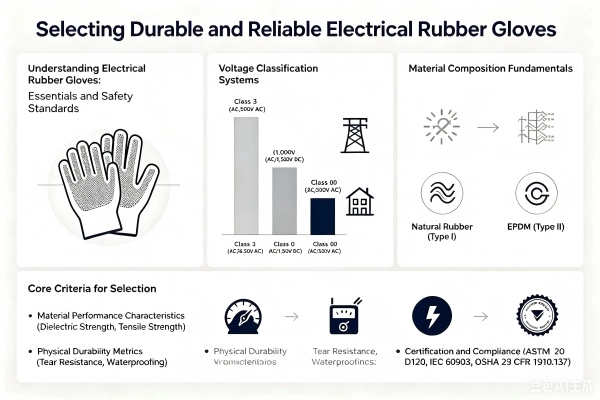
Understanding Electrical Rubber Gloves: Essentials and Safety Standards
Insulating gloves serve as vital protective equipment, insulating users from electrical hazards by preventing current flow through the hands. These specialized barriers transform potentially fatal contact into safe interaction with energized systems, acting as the last line of defense when administrative controls and engineering solutions prove insufficient.
Voltage Classification Systems
There are six different classes in the business, from Class 00 to Class 4. Each class has its own voltage limits. Class 00 Insulating Gloves are the most basic level. They can handle up to 500 Volts AC and 750 Volts DC, which makes them perfect for utility work around the home and repairing EV batteries. Class 0 gloves, which can be identified by their red stickers, protect workers who work with circuits that have up to 1,000 Volts AC and 1,500 Volts DC. This includes people who do low-voltage control work and people who maintain the distribution grid. Class 3 gloves guard up to 26,500 Volts AC, which is what is needed in substations where the chance of an arc flash is higher.
International Standard Alignment
In North America, ASTM D120 sets the rules for testing methods and performance standards, while IEC 60903 sets the rules for compliance in Europe and around the world. The EN standards make the requirements even more detailed for use in different areas. To make sure compliance, safety, and long-term dependability, buying pros must understand these classes and standards when they look at glove choices based on voltage rating, thickness, and material makeup. In these setups, proof test voltages, limit use voltages, and required retesting times are set. These protect workers and companies from being sued.
Material Composition Fundamentals
Natural rubber is the most popular material for electrical rubber gloves because it is more flexible and sensitive to touch, which makes it easier for techs to work with small parts and wire connections. EPDM manufactured rubber is designed to work in certain environments, especially outside, where ozone speeds up the breakdown of natural rubber. Type I designations mean that the material used in electrical rubber gloves is made of natural rubber, and Type II designations mean that it is made of EPDM that doesn't crack when exposed to ozone or UV light.
Core Criteria for Selecting Durable and Reliable Electrical Rubber Gloves
Selecting the ideal gloves requires careful consideration of procurement scenarios, usage patterns, and user ergonomics. Organizations managing large workforces across multiple sites face unique challenges in standardizing protection while accommodating varied voltage exposures and task requirements. The following evaluation framework addresses these complexities systematically.
Material Performance Characteristics
The dielectric strength of a material tells you how well it can keep electricity from breaking down when voltage stress is applied. The tensile strength of natural rubber is usually higher than 14 MPa, and its stretch qualities can reach 700%. This makes it resistant to mechanical tears and punctures. EPDM substitutes give up a little flexibility in exchange for better environmental stability, keeping their insulating properties even when exposed to chemicals and high temperatures. The voltage grade is directly related to the thickness, which ranges from 0.51 mm for Class 00 to several millimetres for high-voltage uses. However, as the thickness rises, it becomes harder to work with.
Physical Durability Metrics
Tensile strength and tear resistance determine how gloves withstand daily handling stress. Testing protocols measure the force required to propagate tears and elongation before failure, predicting field longevity under abrasion and sharp edge contact. Waterproofing ensures insulation integrity in wet conditions, as moisture compromises dielectric properties and creates tracking paths for current flow.
Certification and Compliance Verification
Documented testing records and third-party proof show that a manufacturer is trustworthy. Honest suppliers give proof test papers that show each lot was electrically tested at voltages higher than the listed maximums. OSHA 1910.137 sets specific times for inspections and tests. For example, electrical tests must be done on gloves every six months after they are put into service. According to ASTM F496, gloves that have been sitting on shelves for twelve months or more cannot be given out. Reliability is also affected by a brand's image, since well-known companies often spend on quality control methods that younger companies may not have.
To make the best glove choice, the organised decision-making system weighs safety, sturdiness, cost, and operating conditions. The people in charge of buying things have to compare the costs of getting them right away to the total costs of owning them, which include how often they need to be tested, replaced, and any possible incident costs. When working in difficult environments, organisations value longevity over cost-effectiveness. On the other hand, when working in controlled environments, they may be willing to accept quicker service gaps to save money.
Comparing Top Electrical Rubber Gloves and Brands
Understanding how leading brands perform across durability, voltage ratings, and material quality allows procurement teams to make informed choices when sourcing electrical rubber gloves. The global market presents numerous options, each offering distinct advantages for specific industrial contexts. Here are the core considerations when evaluating major suppliers currently serving B2B procurement channels.
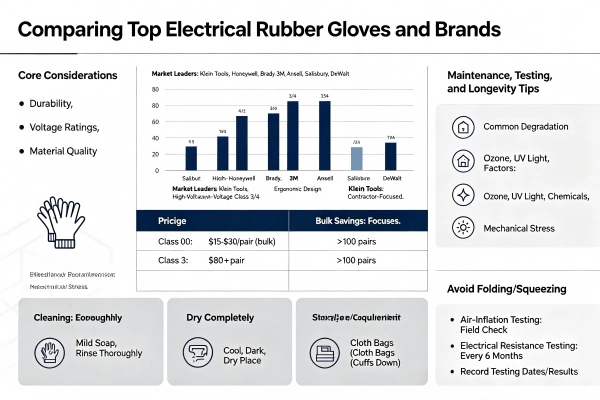
Market leaders, including Klein Tools, Honeywell, Brady, 3M, Ansell, Salisbury, and DeWalt, have established themselves through consistent quality and comprehensive product ranges. Salisbury maintains particular strength in high-voltage classifications, offering Class 3 and Class 4 gloves with proven performance in utility substations. Their products undergo rigorous testing protocols and maintain extensive certification documentation valued by government procurement departments. Ansell differentiates through ergonomic design innovations that reduce hand fatigue during extended wear periods, addressing a common complaint among field technicians. Klein Tools targets the contractor segment with competitively priced options suitable for residential and light commercial applications.
Pricing systems are very different depending on the voltage level, the material makeup, and the size of the order. Class 00 gloves usually cost between $15 and $30 per pair when bought in bulk, but Class 3 protection costs $80 or more per pair because of stricter material standards and more difficult testing. When you buy more than 100 pairs, you can get big savings on bulk orders, and some sellers offer tiered pricing that rewards customers who buy a lot every year. Concerns about availability can delay projects because rare voltage levels or custom sizes may need longer lead times, especially when buying from makers in other countries.
Premium names are different from cheaper options because they have better supplier support. Technical advice services help buying teams figure out the right categories for new uses like battery energy storage systems and installations that use green energy. While warranties usually cover problems with the way the product was made, they don't cover damage caused by wrong use or poor testing. This is why it's important to keep clear records. These benefits successfully solve problems with production consistency while lowering the costs of safety compliance that smaller businesses find hard to handle on their own.
Maintenance, Testing, and Longevity Tips for Electrical Rubber Gloves
Proper maintenance and regular testing are pivotal to extending the service life of insulating gloves while ensuring worker protection remains uncompromised. We have observed that organizations implementing structured maintenance protocols achieve significantly longer glove lifespans and lower incident rates than those treating these items as disposable commodities.
Common Degradation Factors
One of the sneakiest things that can damage natural rubber is contact with ozone. High levels of ozone in the air, like those found near electric motors and welding operations, damage rubber polymer chains by making tiny cracks that spread to the surface and can be seen. In the same way that ultraviolet light breaks down rubber links, storing things outside without safety is especially bad. Chemicals from fuel products, chemicals, and cleaning agents can damage electrical qualities, and the damage is often hard to see. Punctures, cuts, and overstretching that cause mechanical stress either create failure points right away or weaken the structure so that it will break down in the future.
Cleaning and Storage Protocols
How gloves are washed has a big effect on how long they last. Mild soap solutions get rid of dirt and grime without hurting rubber materials, but harsh detergents speed up the breakdown process. Rinsing well gets rid of any leftovers that could attract dirt or chemicals. Mould can't grow, and materials won't get soft if they are completely dried before they are stored. Care must be taken with the storage conditions: materials should be kept in cool, dark, dry places that are out of direct sunlight and ozone sources. When you use cloth bags, make sure the cuffs are down. Do not fold or squeeze them, as this puts stress on the rubber at the folds. Because of the risk of pollution and changes in temperature, steam lines, electricity panels, and outdoor sheds are not good places to store things.
Inspection and Testing Methodologies
Air-inflation testing is a simple way to check something in the field that doesn't need any special tools. Inflate the gloves by squeezing air inside them, then listen and feel for air leaving, which means there are holes or punctures that you can't see. Electrical resistance testing, which must be done on gloves every six months, checks the dielectric stability in a controlled environment. Specialised testing centers put gloves in conductive water baths, apply proof test voltages, and watch for current loss that goes beyond what is accepted. Recording testing dates and outcomes makes people responsible and makes sure that regulations are followed throughout the lifetime of the equipment. This is very important for lowering the risk for the organization and getting the most out of the investment by extending service intervals.
Procurement Strategies: How to Buy and Source Electrical Rubber Gloves Efficiently
Efficient procurement balances buyer requirements across industries, budget constraints, and delivery schedules. Organizations managing complex safety requirements benefit from systematic approaches that align product specifications with actual field conditions while building supplier relationships that support long-term operational needs.
Segmenting Procurement Requirements
Application risk assessment forms the foundation of intelligent purchasing for electrical rubber gloves. High-voltage utility work demands premium classifications with rigorous testing documentation, justifying higher per-unit costs through reduced liability exposure. Light industrial maintenance involving occasional energized circuit interaction may accept Class 00 or Class 0 electrical rubber gloves protection at lower price points. Quantity planning considers not only current workforce size but also replacement cycles, training inventory, and emergency reserves. Volume commitments enable preferential pricing but require accurate forecasting to avoid obsolescence from standard revisions or specification changes.
Supplier Selection and Qualification
By matching the product choice with safety needs and seller dependability, mistakes that cost a lot of money can be avoided. Make sure that any possible partners have the latest certifications and testing tools that are allowed in the areas where you do business. Ask for sample lots that come with all the necessary paperwork, like proof test records and material makeup data sheets. Test how fast technical support is by giving them real-life examples of situations where they need help with a tool. The dependability of delivery is affected by the powers of the distribution network. This is especially true for businesses that operate in more than one area or country. Global providers with regional warehouses cut down on wait times and shipping costs, and they also make it easier to coordinate operations.
Negotiation and Partnership Development
To negotiate prices and terms with wholesalers, it's helpful to first understand how suppliers set their prices. Material prices, testing fees, and maintaining approval are set factors that can't be changed. However, sales profits and volume bonuses can be negotiated. Warranty issues include more than just problems with the way the product was made; they also include testing help and paperwork services. Planning for logistics should include emergency substitute needs, since fast shipping costs can be higher than the value of the gloves when important work needs to be protected. When you build long-term partnerships, you should focus on proactive communication and feedback loops to improve customer happiness and get ready for changing buying needs. This turns business relationships into strategic ties that support the safety culture of your company.
Conclusion
The detailed information in this guide gives global B2B buying teams the tools they need to choose insulated gloves that meet strict safety and durability standards. We looked at voltage classifications, material qualities, compliance frameworks, brand comparisons, upkeep routines, and purchase strategies that help people make smart buying choices. Standards, brand insights, and useful tips are all combined to make sure that it is useful for engineering, manufacturing, and industry workers around the world who are looking for reliable safety gear. When companies put time into structured review methods, they improve safety and lower the total cost of ownership over the lifetime of their tools.
FAQ
1. How often should insulating gloves be tested?
According to ASTM F496 and OSHA 1910.137, gloves must be electrically tested every six months after issue to service. Gloves remaining in storage cannot be issued if they have not been tested within the preceding twelve months. Organizations operating under NFPA 70E may face additional testing requirements based on risk assessments and historical incident data.
2. Are leather protector gloves mandatory?
Leather protectors are mandatory across all voltage classifications. They provide mechanical protection against cuts, abrasions, and punctures that would compromise rubber dielectric integrity. The rubber glove must extend beyond the leather protector to prevent voltage tracking, typically maintaining a minimum two-inch gap distance for Class 3 applications.
3. Can I use the same gloves for AC and DC applications?
Gloves rated for AC voltage applications typically accommodate DC voltages at higher thresholds. Class 3 gloves protect against 26,500 Volts AC but extend to 39,750 Volts DC maximum use voltage. Verify that testing documentation specifically addresses DC-proof voltage if that represents your primary application, although AC testing remains the industry standard practice.
Partner with PPE MAX for Your Electrical Safety Equipment Needs
PPE MAX delivers proven insulating glove solutions backed by decades of manufacturing expertise since 1956. As a trusted electrical rubber gloves supplier serving 134 countries, we understand the procurement challenges facing industrial safety distributors, mining operations, and infrastructure companies. Our comprehensive product line spans Class 00 through Class 4 ratings, supported by complete ASTM and IEC certification documentation that simplifies your compliance verification for electrical rubber gloves. We offer tailored OEM manufacturing capabilities for organizations building proprietary safety programs, combining our technical knowledge with your brand requirements. Contact our specialist team at marketing@ppemax.com for volume pricing on bulk orders, technical consultations matching glove specifications to your voltage environments, and access to our complete product catalog. Our northwest China manufacturing facility maintains inventory depth that supports rapid fulfillment cycles, while our global distribution network ensures reliable delivery across continents. Partner with us for end-to-end solutions that protect your workforce and strengthen your safety culture.
References
1. American Society for Testing and Materials. (2021). ASTM D120-20: Standard Specification for Rubber Insulating Gloves. West Conshohocken, PA: ASTM International.
2. International Electrotechnical Commission. (2019). IEC 60903: Live Working – Gloves of Insulating Material. Geneva: IEC Central Office.
3. Occupational Safety and Health Administration. (2020). 29 CFR 1910.137: Electrical Protective Equipment Standards. Washington, DC: U.S. Department of Labor.
4. National Fire Protection Association. (2021). NFPA 70E: Standard for Electrical Safety in the Workplace. Quincy, MA: NFPA Publications.
5. American Society for Testing and Materials. (2020). ASTM F496-20: Standard Specification for In-Service Care of Insulating Gloves and Sleeves. West Conshohocken, PA: ASTM International.
6. International Safety Equipment Association. (2022). Electrical Protective Equipment Testing and Maintenance Guidelines. Arlington, VA: ISEA Publications.
Learn about our latest products and discounts through SMS or email