- English
- French
- German
- Portuguese
- Spanish
- Russian
- Japanese
- Korean
- Arabic
- Greek
- German
- Turkish
- Italian
- Danish
- Romanian
- Indonesian
- Czech
- Afrikaans
- Swedish
- Polish
- Basque
- Catalan
- Esperanto
- Hindi
- Lao
- Albanian
- Amharic
- Armenian
- Azerbaijani
- Belarusian
- Bengali
- Bosnian
- Bulgarian
- Cebuano
- Chichewa
- Corsican
- Croatian
- Dutch
- Estonian
- Filipino
- Finnish
- Frisian
- Galician
- Georgian
- Gujarati
- Haitian
- Hausa
- Hawaiian
- Hebrew
- Hmong
- Hungarian
- Icelandic
- Igbo
- Javanese
- Kannada
- Kazakh
- Khmer
- Kurdish
- Kyrgyz
- Latin
- Latvian
- Lithuanian
- Luxembou..
- Macedonian
- Malagasy
- Malay
- Malayalam
- Maltese
- Maori
- Marathi
- Mongolian
- Burmese
- Nepali
- Norwegian
- Pashto
- Persian
- Punjabi
- Serbian
- Sesotho
- Sinhala
- Slovak
- Slovenian
- Somali
- Samoan
- Scots Gaelic
- Shona
- Sindhi
- Sundanese
- Swahili
- Tajik
- Tamil
- Telugu
- Thai
- Ukrainian
- Urdu
- Uzbek
- Vietnamese
- Welsh
- Xhosa
- Yiddish
- Yoruba
- Zulu
How to Avoid Counterfeit Dielectric Gloves When Buying?
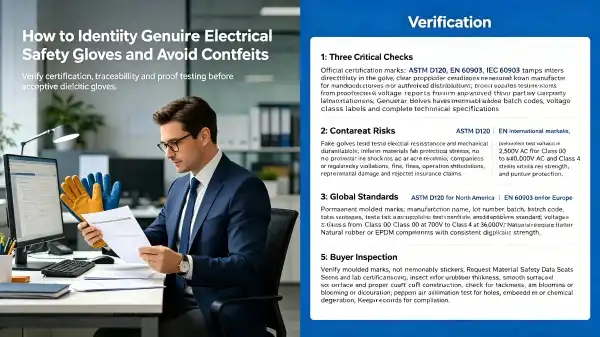
Checking three important things is the first step in avoiding fake electrical safety gloves: official certification marks (ASTM D120, EN 60903, or IEC 60903 stamps directly on the glove); clear supplier credentials from well-known manufacturers or authorised distributors; and proof test voltage reports from approved third-party laboratories. Traceable batch codes, voltage classification labels, and thorough technical specs are all things that real dielectric gloves have that fake ones don't. We've seen buying teams save lives and money by asking these checks up front. This cuts through misleading packaging and prices that seem too good to be true, which are signs that a product is fake.
Understanding the Risks of Counterfeit Dielectric Gloves
Fake electrical insulation gloves are very dangerous for workers and can hurt the reputation of the company. It looks like these fake goods are approved safety gear, but they don't meet the strict standards for electrical resistance and mechanical durability needed in high-voltage settings.
What Defines a Counterfeit Product
A fake electrical safety glove is one that wrongly says it meets international safety standards but hasn't been tested, certified, or manufactured with proper quality control in mind. Often, these fakes have names that are copied, fake certification numbers, and voltage rates that aren't accurate and have nothing to do with real lab testing. Real products are made from natural rubber or EPDM compounds that have been tested and shown to have high dielectric strength. Fake products, on the other hand, are made from inferior materials that fail badly under electrical stress.
Hidden Dangers Behind Fake Gloves
Electrical workers who use fake insulation gloves are immediately putting their lives at risk. When these fake goods come in contact with live wires, they do not protect against shock, arc flash, or electrocution. Aside from the risk of personal harm, companies that use fake PPE face serious legal problems, regulatory violations, and even criminal charges for not ensuring the safety of their workers. When investigations show that fake equipment was used, insurance claims about electrical accidents are often turned down. We've seen procurement offices get hit with million-dollar claims after workers got hurt while working on substation repair with fake gloves.
Global Standards That Counterfeits Ignore
As stated in ASTM D120 (North American standard), EN 60903 (European regulation), and IEC 60903 (international rule), real electrical insulation gloves of dielectric gloves must meet strict requirements. These standards require proof test voltages between 2,500V AC for Class 00 gloves and 40,000V AC for Class 4 gloves. They also set strict mechanical property standards, such as tensile strength, tear resistance, and puncture protection. Manufacturers of fake goods avoid these expensive approval processes on purpose, making gloves that look like real ones but don't have any of the tested safety features. Regulatory agencies like OSHA, CSA, and international labour organisations have strict rules about what equipment is allowed and what is not. Companies caught using non-compliant equipment can be fined, have their operations shut down, and have their reputations hurt.
Key Indicators to Identify Genuine Dielectric Gloves
To tell the difference between real electrical protective gloves and dangerous fakes, you need to know about the materials, certifications, and tracking systems that set tried goods apart from dangerous copies.
Material Composition and Voltage Ratings
Real high-voltage gloves are made of either natural rubber, which is more flexible and dexterous, or EPDM (Ethylene Propylene Diene Monomer), which is more resistant to ozone and UV light. These materials go through special mixing methods that make the dielectric strength the same all the way through the glove. The voltage class of real goods, from Class 00 (maximum use voltage 500V) to Class 4 (maximum use voltage 36,000V), is clearly marked on the gauntlet, either by being moulded in or permanently written on it. The natural "curved-hand" design keeps your hands from getting tired after long periods of use, which is a feature that fakes rarely get right. Colour-coding the inside and outside layers serves a practical purpose by making it easy to quickly check visually for holes or strange objects during the required air filling test.
Certification Marks and Label Verification
Genuine gloves have permanent certification signs that show the name of the maker, the lot or batch number, the voltage class, the date of the test, and the standard that applies (ASTM D120, EN 60903, or IEC 60903). These marks are moulded into the rubber when it is made, not put on with sticky labels that are easy to remove. People who work in procurement should make sure that approval numbers match up with test reports that can be obtained from the maker. Real sources give full paperwork, like Material Safety Data Sheets, test certificates from approved labs, and the ability to fully track back to specific production runs. Products that aren't real usually have marks that aren't clear, general labels without batch codes, or certification numbers that can't be verified when checked against those of standards organisations.
Inspection Protocols B2B Buyers Must Demand
Professional buyers need proof that the electricity system was tested before it can be accepted. Suppliers with a good reputation are happy to share certifications from third-party labs that show they meet proof test voltage and physical property standards. Buyers should insist on seeing or reading the results of the daily air test process, in which the gloves are filled to look for holes, wires inside, or chemical breakdown. A visual check should show that the thickness of the rubber is uniform, there are no mould lines or other production flaws, and the cuffs are properly constructed so that they don't roll over while they're being used. The glove's surface should have a smooth, even texture that doesn't have any tackiness, blooming, or discolouration that could mean the material is breaking down or wasn't cured properly during production.
Comparing Authentic Dielectric Gloves from Leading Brands Versus Counterfeits
Knowing the difference in performance between real and fake goods of dielectric gloves makes it clear why authentication is so important for electricity safety programs.
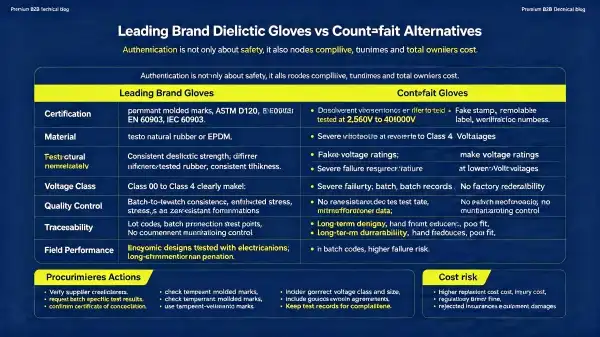
Leading producers put a lot of money into research, quality control, and keeping certifications up to date, which is something that counterfeiters can't do cheaply. Established names make sure that their products work the same way across all batches, and their gloves are known to last longer than cheaper options. Their voltage grade systems are rigorously tested to make sure that Class 2 gloves really do protect workers during 17,000V maximum use situations. New technologies in manufacturing include stress points that are stronger, rubber formulations that don't crack when exposed to ozone, and comfortable designs that have been tested in the field with real electricians. These technical benefits directly lead to less hand fatigue, better tactile awareness for precise work, and reliable safety in case of an emergency.
Fake goods look like leather protectors, regular rubber gloves, or nitrile gloves with fake voltage values printed on them. True dielectric gloves have basic electrical protection qualities that these don't have. Real Class 0 gloves are proof-tested at 5,000V AC and are proven to protect up to 1,000V of the highest use voltage. Fake gloves, on the other hand, fail severely at much lower voltages. If you buy fake gloves, you might save some money at first, but that money quickly goes away when you consider how often you have to replace them, how much injuries cost, fines from the government, and lost work time because of broken equipment. Total ownership analysis regularly shows that approved gloves from verified sources offer better value, even if they cost more at first. This is especially true for companies that are in charge of large-scale electrical repair programs at multiple sites.
Best Practices for Procurement: How to Safely Buy Dielectric Gloves
Using systematic buying methods stops fake goods from getting in while also protecting workers and following the rules.
Sourcing from Verified Suppliers
It is recommended that procurement teams only work with certified makers and authorised distributors who handle their supply chains in a clear way. We suggest that you ask for a supplier's full qualifications, such as business licenses, ISO certifications, and proof of partnerships with well-known safety equipment makers. Since 1956, well-known providers like PPE MAX have built their names on delivering high-quality goods on time, having strict quality control systems in place, and being able to fully trace the manufacturing process. Verified wholesalers provide detailed product history paperwork that clearly shows who owns the product from the time it is made in the plant to the time it is delivered. This openness stops fake goods from getting into real supply lines at weak places in the distribution chain, which is where fake goods usually get in.
Documentation and Ordering Considerations
Bulk purchase deals should clearly state that they need a certificate of conformity paperwork, test results that are specific to the batch, and protection clauses that ensure delivery of genuine goods. There are chances for custom branding with trustworthy makers who can add company names or identification marks during production. This adds another layer of security and helps with brand recognition programs. Secure delivery methods, such as secure packaging, tamper-evident cases, and direct sending from the maker, lower the chances of fakes being substituted during transit. Choosing the right size is very important because gloves that don't fit right hurt your agility and safety, no matter how real they are. The technical specs should talk about the uses that the product is meant for, like maintaining power grids that need Class 2 or Class 3 protection, making electric cars that need Class 0 or Class 00 precision handling, or working in industrial substations that need Class 3 or Class 4 ratings and leather protector compatibility.
Maintenance, Inspection, and Long-Term Use to Prevent Glove Failure
Systematic care practices of dielectric gloves make sure that protective gear lasts as long as possible while still doing its job of keeping people safe.
Daily Inspection Techniques
Before an electrical exposure, every glove release needs to be checked for risk by inflating it with air. Workers should blow up the glove, roll the cuff to keep the air inside, and then gently press on it while watching for air leaks that could mean holes, cracks, or other damage. A visual inspection is needed to find ozone checking (small cracks on the surface), foreign materials buried in the material, chemical poisoning, or damage from mechanical stress. OSHA requires these checks to be done and records to be kept that show they are done in accordance with standards for inspection frequency. The check after use follows the same steps, which makes sure that the gloves go back to storage in a safe state.
Storage and Cleaning Standards
Electrical insulation gloves need to be kept in cool, dark, dry places that are out of direct sunlight, away from sources of ozone, and away from temperature changes. Putting the ends of canvas storage bags down stops them from getting damaged by tension and from getting dirty. When you fold or squeeze gloves, you make lasting stress points that weaken their insulating properties over time. Mild soap and water at temperatures below 120°F (49°C) are used for cleaning, and the items must be completely dry before they can be stored. Chemical cleaners, products made from gasoline, and too much heat can break down rubber, which makes it less effective at protecting against electricity and speeds up the failure of the material.
Retirement Criteria and Replacement Scheduling
Even with proper care, all electrical safety gloves need to be thrown away every so often based on electrical testing plans and eye condition assessments. Electrical testing of gloves is required by ASTM and OSHA every six months or right away if there are worries about their durability. As part of the testing process, the device is submerged in water, and high voltage is applied to measure any leaking current. If the device fails, it must be thrown away right away. Surface cracks that go beyond casual checking, holes or cuts of any size, chemical pollution that changes the properties of the rubber, and too much stiffness are all physical signs that the material is breaking down. Procurement systems should plan for when to repair things, making sure they have enough on hand to keep broken equipment from being used for longer than it should be and to keep operations running while maintenance routines are being followed.
Conclusion
If a company wants to do safety-critical work, it should not use fake electrical insulation gloves because they pose unacceptable risks. Electrical workers of all voltage levels can be sure they are safe by using verified licenses, clear source ties, and written tests to prove their legitimacy. These buying strategies—requiring proof of ASTM D120, EN 60903, and IEC 60903 compliance, buying from well-known companies, and putting in place systematic inspection protocols—get rid of fake goods while supporting regulatory compliance. Companies that buy real goods from trustworthy sellers protect their employees, lower their overall costs, and keep up operating ethics, all of which fake goods can't do.
FAQ
1. How Can I Verify ASTM or IEC Certification on Gloves?
Authentic certification has permanent marks moulded into the rubber that include the standard name (ASTM D120 or IEC 60903), voltage class, maker name, and a unique batch or lot number. Use information from the manufacturer's website to get in touch with them directly and make sure that the batch number matches their real production records and testing paperwork. Ask for copies of test reports from a third-party lab that show the results of the proof test voltage and compliance checks.
2. How Often Should Electrical Insulation Gloves Be Retested?
Electrical tests must be done on gloves that are still being used every six months, no matter how good they look. Also, companies need to test gloves again right away if they think they've been exposed to chemicals, electrical stress, or mechanical damage that could weaken their protective qualities. Keeping written records of testing plans ensures that regulations are followed and workers are safe.
3. What Should I Do If I Suspect Counterfeit Products?
Right away, take gloves that might not be real out of service and put them in a separate area so they don't get used by chance. Write down all of the product markings, details about the seller, and records of purchases. Get in touch with your purchasing department and safety management team to start the investigation process. Tell regulatory agencies, such as OSHA and important standards organisations, about fake goods. Hire trusted sellers to find new equipment that comes with the right proof of ownership.
Partner With PPE MAX for Certified Electrical Protection Solutions
To protect your employees, you need to work with providers who have a track record of unwavering quality standards and decades of proven dependability. Since 1956, PPE MAX has been making approved electrical safety equipment for businesses in 134 countries. Their goods are real and meet or exceed ASTM D120 and international compliance standards. Our full range of dielectric glove provider services includes custom OEM production, private label branding, and full technical support, from choosing the right voltage class to providing maintenance training programs. Because we know that real safety can't be compromised, we try every product ourselves. Email our purchasing agents at marketing@ppemax.com to talk about your unique electrical safety needs, get detailed product certifications, or get bulk discounts for long-term supply deals. Your employees deserve real security that comes from 68 years of industry experience and an unwavering dedication to safety on the job.
References
1. American Society for Testing and Materials. (2021). ASTM D120-20: Standard Specification for Rubber Insulating Gloves. ASTM International Standards Organisation.
2. International Electrotechnical Commission. (2019). IEC 60903:2019 - Live Working - Gloves of Insulating Material. IEC Technical Committee Standards Publication.
3. European Committee for Electrotechnical Standardisation. (2020). EN 60903:2020 - Live Working - Electrical Insulating Gloves. CENELEC European Standards Authority.
4. Occupational Safety and Health Administration. (2022). OSHA 1910.137: Electrical Protective Equipment Standards and Inspection Requirements. U.S. Department of Labour Regulatory Guidelines.
5. National Safety Council. (2023). Electrical Safety in Industrial Environments: Risk Assessment and PPE Selection Criteria. NSC Workplace Safety Research Division.
6. Institute of Electrical and Electronics Engineers. (2021). IEEE Standards for Electrical Safety Practices in Industrial and Commercial Applications. IEEE Power and Energy Society Technical Publications.
Learn about our latest products and discounts through SMS or email