- English
- French
- German
- Portuguese
- Spanish
- Russian
- Japanese
- Korean
- Arabic
- Greek
- German
- Turkish
- Italian
- Danish
- Romanian
- Indonesian
- Czech
- Afrikaans
- Swedish
- Polish
- Basque
- Catalan
- Esperanto
- Hindi
- Lao
- Albanian
- Amharic
- Armenian
- Azerbaijani
- Belarusian
- Bengali
- Bosnian
- Bulgarian
- Cebuano
- Chichewa
- Corsican
- Croatian
- Dutch
- Estonian
- Filipino
- Finnish
- Frisian
- Galician
- Georgian
- Gujarati
- Haitian
- Hausa
- Hawaiian
- Hebrew
- Hmong
- Hungarian
- Icelandic
- Igbo
- Javanese
- Kannada
- Kazakh
- Khmer
- Kurdish
- Kyrgyz
- Latin
- Latvian
- Lithuanian
- Luxembou..
- Macedonian
- Malagasy
- Malay
- Malayalam
- Maltese
- Maori
- Marathi
- Mongolian
- Burmese
- Nepali
- Norwegian
- Pashto
- Persian
- Punjabi
- Serbian
- Sesotho
- Sinhala
- Slovak
- Slovenian
- Somali
- Samoan
- Scots Gaelic
- Shona
- Sindhi
- Sundanese
- Swahili
- Tajik
- Tamil
- Telugu
- Thai
- Ukrainian
- Urdu
- Uzbek
- Vietnamese
- Welsh
- Xhosa
- Yiddish
- Yoruba
- Zulu
How often should insulating gloves be tested?
Insulating gloves must undergo electrical testing every six months according to OSHA standards, with additional daily visual inspections performed by users before each use. The testing frequency can vary based on specific working conditions, voltage levels, and manufacturer recommendations. Proper testing schedules ensure these critical safety components maintain their electrical insulation properties and protect workers from electrical hazards. Regular testing combined with proper maintenance extends glove lifespan while ensuring compliance with safety regulations across industrial applications.
Understanding Insulating Gloves and Their Safety Standards
Material Composition and Electrical Properties
Insulating gloves utilize specialized materials planned to anticipate electrical current from passing through to the wearer. Characteristic elastic latex remains the most common fabric due to its prevalent electrical separator properties and adaptability. The fabricating handle includes numerous layers of elastic compounds that make a dependable boundary against electrical current, whereas keeping up ability for workers.
PPE MAX fabricates Lesson 00 protection gloves utilizing high-grade normal elastic latex with a 0.5mm normal thickness. Our gloves highlight an AC greatest utilization voltage of 500V with an AC confirmation test rating of 2500V, making them perfect for low-voltage applications. The ergonomic plan guarantees improved ability and consolation amid amplified wear periods.
Voltage Classification Systems
International benchmarks for insulating gloves set up voltage evaluations that offer assistance for experts select fitting safety levels. The ASTM D120 standard classifies gloves into six classes (00, 0, 1, 2, 3, and 4) based on the most extreme utilization voltage evaluations. Also, the IEC 60903 standard gives comparable classifications for universal markets.
Class 00 gloves, such as those fabricated by PPE MAX, ensure against voltages up to 500V AC and 750V DC. These gloves serve electric utility work, broadcast communications establishments, mechanical and electrical upkeep, HVAC framework repairs, and low-voltage research facility testing. Our items comply with both ASTM D120 and IEC 60903 measures, guaranteeing worldwide acknowledgment and administrative compliance.
Certification and Quality Assurance
Proper certification ensures that electrical security gloves meet thorough execution measures. PPE MAX keeps up comprehensive certifications counting ASTM D120 compliance, IEC 60903 certification, and CE certification for European markets. Extra territorial certifications are accessible upon ask to meet particular advertising requirements.
Quality confirmation expands past initial certification to incorporate thorough manufacturing controls and testing conventions. Our decades of fabricating mastery since 1956 have built up strong quality control forms that guarantee steady execution across all product groups. Each glove gets clear stamping with course assignment, estimate data, and test dates for simple distinguishing proof and tracking.
How Often Should Insulating Gloves Be Tested? — Criteria and Guidelines?
Regulatory Testing Requirements
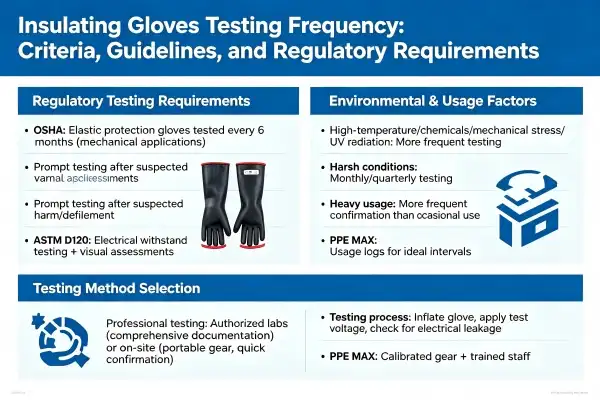
OSHA benchmarks command electrical testing of elastic protection gloves each six months, with this timeline serving as the pattern for most mechanical applications. In any case, particular working conditions may require more frequent testing intervals to keep up satisfactory security levels. The standard, moreover, requires prompt testing after any suspected harm or defilement that seems to compromise electrical cover properties.
ASTM D120 gives point-by-point testing methods that incorporate electrical withstand testing and intensive visual assessments. The electrical test applies an indicated voltage to confirm the glove maintains its separator keenness all through the testing period. Visual review looks at the glove surface for cuts, punctures, implanted outside objects, or other harm that might cause electrical pathways.
Environmental and Usage Factors
Working environment conditions essentially impact testing recurrence necessities beyond standard six-month intervals. High-temperature situations, introduction to chemicals, mechanical push, and bright radiation can accelerate fabric deterioration and require more frequent testing. Mechanical offices with unforgiving conditions may execute month to month or quarterly testing plans to guarantee continued protection.
Usage concentrated moreover influences testing plans, with intensely utilized gloves requiring more frequent confirmation than once in a while utilized gear. Laborers performing day by day electrical support errands uncover their defensive gear to more prominent stretch compared to emergency-only applications. PPE MAX prescribes keeping up point-by-point utilization logs to offer assistance decide ideal testing intervals for particular applications.
Testing Method Selection
Professional electrical testing can be performed through authorized research facilities or on-site, utilizing versatile testing gear. Research facility testing gives a comprehensive investigation with nitty-gritty documentation, whereas versatile analyzers offer quick confirmation capabilities for operational adaptability. Both strategies must meet the voltage and current determinations laid out in important security standards.
The testing handle includes blowing up the glove and applying the indicated test voltage while checking for electrical spillage. Any perceptible current stream demonstrates separator disappointment and requires prompt glove evacuation from the benefit. PPE MAX prescribes keeping up calibrated testing gear and prepared staff to guarantee precise results and legitimate translation of test data.
Best Practices for Maintaining and Testing Insulating Gloves
Daily Inspection Procedures
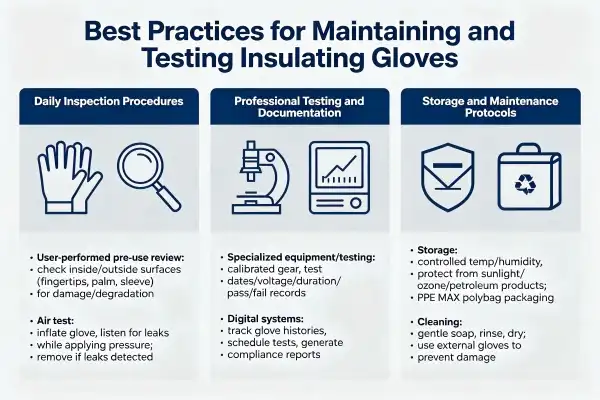
User-performed insulating gloves reviews speak to the most basic line of defense against glove disappointment. Specialists must look at their defensive hardware, sometimes recently, each utilize, looking for obvious harm, defilement, or signs of disintegration that may compromise security. This review ought to incorporate both insides and outside surfaces, paying specific consideration to fingertips, palm regions, and sleeve locales where harm commonly occurs.
The discuss test gives a compelling field review strategy where clients blow up the glove and tune in for discuss spills while applying tender weight. Any recognized discussion of misfortune demonstrates potential electrical pathway improvement and requires quick glove removal from benefit. PPE MAX plans our Course 00 gloves with improved solidness highlights that stand up to common harm modes, while keeping up adaptability for expanded wear comfort.
Professional Testing and Documentation
Professional testing requires specialized gear and prepared faculty to guarantee precise results and legitimate documentation. Testing offices must keep calibrated gear that meets the voltage and current determinations laid out in appropriate guidelines. Appropriate record-keeping incorporates test dates, voltage levels connected, the term of testing, and pass/fail results for each glove tested.
Documentation administration becomes especially vital for organizations overseeing huge glove inventories over numerous areas. Computerized frameworks can screen personnel's glove histories, plan upcoming tests, and produce compliance reports for administrative reviews. PPE MAX bolsters clients with comprehensive certification documentation and specialized direction to streamline their testing and record-keeping processes.
Storage and Maintenance Protocols
Proper capacity conditions altogether amplify glove life expectancy while keeping up electrical security execution. Capacity ranges ought to keep up controlled temperature and stickiness levels while securing gloves from coordinate daylight, ozone exposure, and contact with petroleum-based items. PPE MAX gives a person a polybag bundling that secures gloves amid capacity and transportation, while maintaining fabric integrity.
Cleaning methods must dodge materials that might compromise elastic astuteness or remove conductive buildups. Gentle cleanser arrangements followed by careful flushing and total drying give successful cleaning without fabric harm. Defensive external gloves ought to be utilized with protective gloves to avoid cuts, punctures, and contamination that may require early replacement.
Comparison of Insulating Glove Types and Their Testing Needs
Material Performance Characteristics
Natural elastic latex offers prevalent electrical cover properties combined with fabulous adaptability and strength for most applications. This fabric gives dependable assurance over wide temperature ranges while keeping up the ability required for accurate electrical work. PPE MAX utilizes high-grade characteristic elastic latex in our Course 00 gloves, guaranteeing ideal execution characteristics for low-voltage applications.
Alternative materials like engineered elastic compounds may offer particular preferences in certain chemical situations or temperature extremes. In any case, characteristic elastic latex remains the favored choice for common electrical work due to its demonstrated execution record and cost-effectiveness. The fabric choice handle ought to consider application necessities, natural conditions, and client comfort factors.
Voltage Class Considerations
Lower voltage classifications like Lesson 00 ordinarily require standard six-month testing intervals due to decreased electrical push levels. Higher voltage classes may require more visit testing due to expanded electrical field stresses and potential for quick debasement. PPE MAX Lesson 00 gloves with 500V AC greatest utilize voltage give solid security for utility work, broadcast communications, and mechanical upkeep applications.
Testing conventions stay reliable over voltage classes, but acknowledgment criteria may shift based on the electrical push levels included. Higher voltage applications regularly utilize more rigid pass/fail criteria and may require extra testing parameters beyond standard electrical withstand tests. Understanding these qualifications makes a difference when experts set up suitable testing plans for their particular applications.
Design and Construction Variations
Glove length influences both security levels and testing prerequisites, with longer gloves giving expanded arm security but requiring extra review focuses. PPE MAX offers Lesson 00 gloves in both 11-inch and 14-inch lengths to suit distinctive application necessities. The 14-inch length gives extra lower arm security for applications including higher voltage presentation or expanded reach requirements.
Weight contemplations affect client acknowledgment and compliance with security methods. Our Lesson 00 gloves keep up a reference weight of roughly 170g while providing fundamental assurance and toughness. This lightweight plan diminishes client weakness amid extended wear periods while keeping up the auxiliary judgment required for electrical security applications.
PPE MAX: Your Trusted Partner for Premium Insulating Gloves
Manufacturing Excellence Since 1956
PPE MAX has served as a driving producer of individual defensive hardware for over six decades, establishing itself as the biggest PPE provider in Northwest China. Our broad experience ranges from 67 years of ceaseless development and quality enhancement, serving utilities, broadcast communications companies, and mechanical clients in over 134 nations around the world. This worldwide reach illustrates our commitment to assembling different security necessities and administrative standards.
Our fabricating capabilities include comprehensive electrical security arrangements with specific ability in protection gloves and respiratory security hardware. The profundity of our involvement empowers us to address the special challenges confronted by diverse businesses and create custom-fitted arrangements that meet particular application prerequisites. We take pride in our part as gatekeepers of working environment security, knowing that our items offer assistance specialists return home securely each day.
Class 00 Insulating Gloves Specifications
PPE MAX Class 00 insulating gloves feature comprehensive specifications designed for optimal performance in low-voltage applications. Our products accommodate an AC maximum use voltage of 500V with AC proof test ratings of 2500V, providing reliable protection with appropriate safety margins. Available lengths include 11-inch and 14-inch options to meet different application requirements and user preferences.
Product sizing ranges from size 8 through size 11 to accommodate diverse workforce requirements. Color options include both red and black varieties to meet specific organizational preferences or safety protocols. Each pair weighs approximately 170g, ensuring lightweight comfort without compromising protection levels or durability requirements.
Here are the key advantages that make PPE MAX Class 00 gloves the preferred choice for electrical safety applications:
• Superior electrical insulation properties - Our high-grade natural rubber latex construction provides reliable protection against electrical hazards while maintaining flexibility for extended wear periods across diverse working conditions.
• Enhanced durability and longevity - Rigorous quality control processes and premium materials ensure extended service life, reducing replacement costs and maintaining consistent protection levels throughout the glove lifecycle.
• Ergonomic design optimization - Careful attention to hand ergonomics provides enhanced dexterity and comfort, encouraging proper usage while reducing user fatigue during extended work periods.
• Comprehensive certification compliance - Full compliance with ASTM D120 and IEC 60903 standards ensures global acceptance and regulatory compliance across international markets and applications.
These advantages effectively address the primary concerns of procurement professionals seeking reliable electrical safety protection while managing cost considerations and user acceptance factors.
Global Supply Chain and Support Services
Our global shipping capabilities ensure reliable product delivery across international markets with comprehensive logistics support. Bulk packaging options accommodate large-scale procurement requirements while custom packaging solutions meet specific organizational needs. We maintain competitive pricing structures for bulk orders while providing customization options that address unique application requirements.
Technical support services include comprehensive product training, dedicated support hotlines, and rapid response to customer inquiries and issues. Our team of experienced professionals provides consultation on product selection, testing protocols, and maintenance procedures to optimize safety program effectiveness. This commitment to customer support extends throughout the product lifecycle, ensuring maximum value from your protective equipment investment.
Conclusion
Regular testing of insulating gloves represents a critical component of comprehensive electrical safety programs. The standard six-month testing interval provides a baseline, but specific working conditions may require more frequent verification to maintain adequate protection levels. Proper maintenance practices, including daily inspections and appropriate storage conditions, extend glove lifespan while ensuring continued safety performance.
PPE MAX offers proven solutions for organizations seeking reliable electrical safety protection through our Class 00 insulating gloves and comprehensive support services. Our decades of manufacturing excellence, combined with global supply capabilities, provide the foundation for successful safety programs across diverse industrial applications. Understanding proper testing frequencies and maintenance requirements enables procurement professionals to make informed decisions that protect their workforce while optimizing equipment investments.
FAQ
How can I tell when insulating gloves need replacement?
Immediate replacement is warranted when visual inspection reveals cuts, punctures, embedded foreign objects, or any surface damage that could compromise electrical insulation. Chemical contamination, excessive wear patterns, or failure to pass electrical testing also requires immediate removal from service. Age-related deterioration may necessitate replacement even when gloves pass electrical tests if material degradation affects user confidence or comfort.
What are the differences between on-site and laboratory testing methods?
On-site testing allows immediate verification of glove integrity using portable equipment, providing operational flexibility and reduced downtime. Laboratory testing offers comprehensive analysis with detailed documentation and typically more precise measurement capabilities. Both methods must meet applicable voltage and current specifications, but laboratory testing may provide additional analysis parameters and more detailed reporting for compliance documentation.
Which certifications should I look for when purchasing insulating gloves?
ASTM D120 compliance ensures adherence to North American safety standards, while IEC 60903 certification provides international recognition. CE marking indicates compliance with European safety requirements. Look for clear marking on each glove indicating class designation, size, and test date information. PPE MAX maintains all relevant certifications and provides documentation to support your compliance verification requirements.
Partner with PPE MAX for Superior Electrical Safety Solutions
Procurement professionals seeking reliable insulating gloves manufacturer partnerships will find exceptional value in PPE MAX's comprehensive electrical safety solutions. Our Class 00 gloves combine proven performance with competitive pricing for bulk procurement requirements. Since 1956, we have maintained our position as a trusted supplier through consistent quality, reliable delivery, and responsive customer support across 134 countries worldwide.
Contact our experienced team at marketing@ppemax.com to discuss your specific electrical safety requirements and explore our certified product range. We provide personalized consultation services that help optimize your procurement strategy while ensuring compliance with applicable safety standards. Our commitment to excellence extends beyond product delivery to include ongoing technical support and training services that maximize your safety program effectiveness.
References
1. Occupational Safety and Health Administration. Personal Protective Equipment for Electrical Workers: Standards and Guidelines. U.S. Department of Labor, 2019.
2. American Society for Testing and Materials. ASTM D120-19 Standard Specification for Rubber Insulating Gloves. ASTM International, West Conshohocken, PA, 2019.
3. International Electrotechnical Commission. IEC 60903:2019 Live working - Gloves of insulating material. Geneva: IEC, 2019.
4. National Institute for Occupational Safety and Health. Criteria for a Recommended Standard: Working in Confined Spaces. DHHS (NIOSH) Publication No. 80-106, Cincinnati, OH, 1979.
5. Institute of Electrical and Electronics Engineers. IEEE Standard 1048-2003: IEEE Guide for Protective Grounding of Power Lines. New York: IEEE Press, 2003.
6. Canadian Standards Association. CSA Z462-18 Workplace electrical safety. Toronto: CSA Group, 2018.
Learn about our latest products and discounts through SMS or email