- English
- French
- German
- Portuguese
- Spanish
- Russian
- Japanese
- Korean
- Arabic
- Greek
- German
- Turkish
- Italian
- Danish
- Romanian
- Indonesian
- Czech
- Afrikaans
- Swedish
- Polish
- Basque
- Catalan
- Esperanto
- Hindi
- Lao
- Albanian
- Amharic
- Armenian
- Azerbaijani
- Belarusian
- Bengali
- Bosnian
- Bulgarian
- Cebuano
- Chichewa
- Corsican
- Croatian
- Dutch
- Estonian
- Filipino
- Finnish
- Frisian
- Galician
- Georgian
- Gujarati
- Haitian
- Hausa
- Hawaiian
- Hebrew
- Hmong
- Hungarian
- Icelandic
- Igbo
- Javanese
- Kannada
- Kazakh
- Khmer
- Kurdish
- Kyrgyz
- Latin
- Latvian
- Lithuanian
- Luxembou..
- Macedonian
- Malagasy
- Malay
- Malayalam
- Maltese
- Maori
- Marathi
- Mongolian
- Burmese
- Nepali
- Norwegian
- Pashto
- Persian
- Punjabi
- Serbian
- Sesotho
- Sinhala
- Slovak
- Slovenian
- Somali
- Samoan
- Scots Gaelic
- Shona
- Sindhi
- Sundanese
- Swahili
- Tajik
- Tamil
- Telugu
- Thai
- Ukrainian
- Urdu
- Uzbek
- Vietnamese
- Welsh
- Xhosa
- Yiddish
- Yoruba
- Zulu
Class 1 Insulating Gloves: Combining Comfort with Electrical Defense
Class 1 Insulating Gloves represent the gold standard for electrical safety equipment, offering comprehensive protection against electrical hazards up to 7,500 volts AC while maintaining the comfort and dexterity workers need to perform their duties effectively. These specialized rubber gloves serve as the primary barrier between electrical workers and potentially lethal voltage levels, making them indispensable safety equipment across numerous industries. At PPE MAX, we understand that true protection comes not just from meeting safety standards but from creating products that workers will consistently use because they enhance, rather than hinder, job performance.
Understanding Class 1 Insulating Gloves: Safety and Standards
Electrical insulating gloves classified as Class 1 provide essential protection for workers exposed to low-voltage electrical systems. These gloves are engineered to safeguard against electrical hazards up to 7,500 volts AC or 11,250 volts DC, making them suitable for most industrial and construction applications involving electrical work.
Primary Applications and Industry Usage
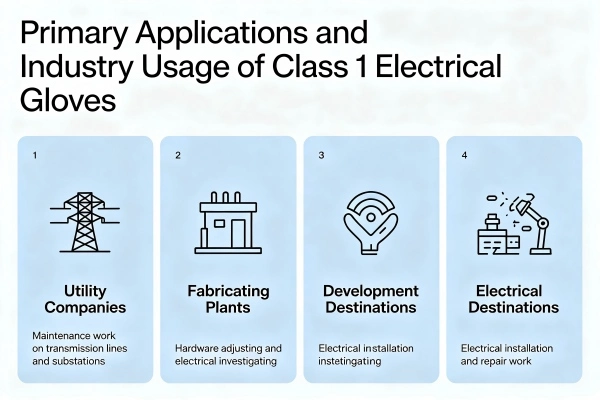
Class 1 electrical gloves serve basic parts over different segments. Utility companies rely on these gloves for maintenance work on transmission lines and substations. Fabricating plants utilize them in hardware adjusting and electrical investigating. Development destinations require them for electrical installation and repair work. Broadcast communications specialists depend on them when working with close control lines or electrical equipment. The flexibility of these protection gloves expands to mechanical upkeep operations where specialists experience different electrical frameworks day by day. Mining operations, vitality offices, and infrastructure ventures all benefit from the security these gloves provide against inadvertent electrical contact.
International Standards and Compliance Requirements
Compliance with thorough universal guidelines guarantees that electrical security gloves meet uniform security levels around the world. The ASTM D120 standard oversees electrical protective gear details in North America, whereas IEC 60903 gives universal rules for protective gloves. These measures command particular testing strategies, including confirmation testing at 10,000V AC and least withstand voltages of 20,000V AC. European markets require CE stamping certification, which confirms compliance with pertinent European Union security mandates. OSHA requires in the United States that customary testing and appropriate maintenance procedures be performed for all electrical protective gear. Understanding these certification necessities makes a difference in obtaining experts' guarantee their buys meet administrative obligations.
Material Composition and Ergonomic Design Features
High-quality characteristic Class 1 Insulating Gloves, the establishment of prevalent protection gloves, giving amazing electrical resistance whereas keeping up adaptability. The fabric composition incorporates ozone and UV resistance, added substances that anticipate debasement amid open air utilize. Multi-layer development improves both security and consolation, with thickness extending from 0.7mm to 1.5mm depending on particular application requirements. Ergonomic plan contemplations incorporate formed finger development that keeps up common hand situating amid amplified wear. Color-coded sleeves empower fast distinguishing proof of glove classifications, diminishing the chance of utilizing unseemly security levels. Upgraded hold designs on palm and finger surfaces progress instrument handling and decrease weakness amid exactness work.
Comparing Class 1 vs Class 2 Electrical Gloves
Understanding the refinements between glove classifications makes a difference guarantee fitting assurance choice. Course 1 gloves ensure against voltages up to 7,500V AC, making them reasonable for most mechanical electrical work. Course 2 gloves expand assurance to 17,000V AC, outlined for higher voltage applications such as transmission line work. The physical contrasts incorporate expanded thickness and weight in Lesson 2 gloves, which may decrease the ability for point-by-point work. Course 1 gloves offer an ideal balance between assurance and execution for the majority of electrical tasks experienced in mechanical settings. Fetched contemplations moreover favor Course 1 gloves for applications that do not require higher voltage protection.
Maintaining and Testing Class 1 Insulating Gloves for Long-Term Reliability
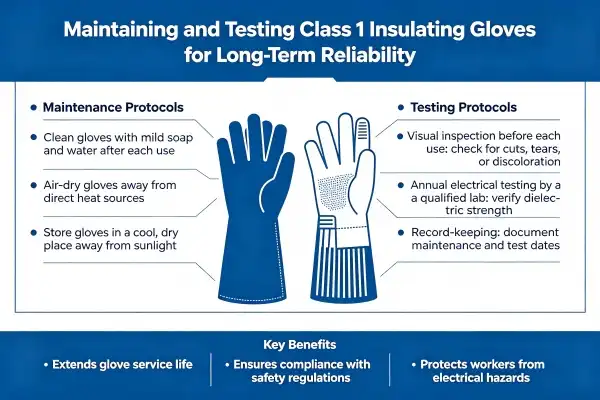
Proper maintenance and regular testing protocols ensure that electrical protective gloves continue providing reliable protection throughout their service life. These practices not only extend glove longevity but also maintain compliance with safety regulations and protect workers from electrical hazards.
Visual Inspection and Electrical Testing Procedures
Daily visual assessments speak to the establishment of glove support programs. Laborers ought to look at gloves for cuts, punctures, inserted remote objects, or signs of ozone splitting after each use. Expansion testing makes a difference in recognizing little gaps or weak spots that might not be unmistakable amid standard inspection. Electrical testing must happen every six months, agreeing to ASTM D120 benchmarks, performed by qualified testing offices utilizing specialized equipment. This testing confirms that gloves keep up their electrical judgment and meet voltage withstand requirements. Documentation of all testing underpins administrative compliance and gives proof of legitimate security program management.
Proper Cleaning Methods and Storage Techniques
Effective cleaning conventions protect glove materials, whereas expelling contaminants that seem to compromise assurance. Gentle cleanser and warm water give secure cleaning for most applications, maintaining a strategic distance from unforgiving chemicals that might debase elastic compounds. Intensive washing expels cleanser buildup that seems to pull in dirt or cause skin irritation. Storage hours essentially affect glove life expectancy and execution. Gloves ought to be put away in cool, dry areas absent from coordinate daylight and ozone sources such as electric engines or welding gear. Appropriate capacity holders secure against physical harm while keeping up legitimate ventilation. Dodging capacity close to petroleum items avoids chemical contamination that may compromise electrical properties.
Determining Replacement Intervals and Lifecycle Management
Multiple components impact glove substitution plans, including recurrence of use, natural presentation, and support quality. Overwhelming day by day utilize may require replacement every six months, whereas incidental use might extend the battery's life to two years with proper care. Natural variables such as extraordinary temperatures, chemical introduction, or UV radiation quicken maturing and require more frequent replacement. Procurement supervisors benefit from setting up precise substitution programs that adjust security necessities with taken a toll proficiency. Following utilization designs and disappointment modes makes a difference in optimizing substitution plans while keeping up satisfactory security edges. Early substitution of gloves, appearing signs of debasement, anticipates security episodes and maintains administrative compliance.
Selecting the Best Class 1 Insulating Gloves for Your Business Needs
Choosing appropriate electrical protective gloves requires careful consideration of multiple factors that impact both safety and operational efficiency. The selection process involves evaluating protection requirements, comfort features, durability characteristics, and cost considerations to identify optimal solutions for specific applications.
Key Criteria for Procurement Teams
Durability stands as an essential thought when assessing glove alternatives for mechanical applications. High-quality elastic compounds stand up to punctures, tears, and natural corruption whereas keeping up electrical properties over extended periods. Adaptability influences specialist consolation and efficiency, especially during assignments requiring fine motor control or extended wear periods. Proper fit guarantees both security and execution, as ineffectively fitting gloves can slip amid utilize or limit development. Measuring consistency over distinctive generation clumps makes a difference in keeping up stock administration proficiency. Certification documentation gives fundamental proof of compliance with appropriate security guidelines and administrative requirements.
Balancing Protection with User Comfort
Modern protection gloves join Class 1 Insulating Gloves that upgrade comfort without compromising assurance levels. Lightweight development decreases hand weakness amid expanded wear, making strides laborer acknowledgment and compliance with security conventions. Improved ability highlights empower exact control of apparatuses and hardware, while keeping up full electrical protection. Breathable liner compatibility permits laborers to utilize cotton or manufactured liners that assimilate dampness and provide extra comfort during hot climate operations. Ergonomic forming takes after common hand forms to decrease weight focuses and improve blood circulation amid drawn out utilize. These consolation highlights contribute to higher utilization rates and superior overall security performance.
Comparing Insulating Gloves with Alternative Hand Protection
Understanding when specialized electrical gloves are required versus common work gloves makes a difference in guaranteeing suitable security determination. Calfskin work gloves give great mechanical security but offer no electrical protection, making them unsuitable for electrical work. Cut-resistant gloves secure against sharp objects but do not have the electrical properties required for live electrical work. Rubber protection gloves are the ideal choice for coordinated electrical contact security. Combination approaches might utilize calfskin defender gloves over protection gloves to upgrade mechanical security while maintaining electrical security. Fetched investigation ought to consider the fundamental nature of electrical assurance when laborers confront stun hazards.
Evaluating Supplier Reliability and Global Brand Options
Supplier selection impacts product quality, delivery reliability, and ongoing support services. Established manufacturers with extensive electrical safety experience typically provide more consistent quality and better technical support than newer market entrants. Global supply chain capabilities ensure product availability across multiple markets and support international operations. Manufacturing quality systems certification, such as ISO 9001, indicates systematic approaches to quality control and continuous improvement. Long-term supplier relationships enable better customization options and more favorable pricing structures for bulk purchases. Technical support services, including training and consultation, add value beyond the basic product offering.
Procurement Insights: How and Where to Buy Class 1 Insulating Gloves?
Strategic procurement of electrical safety equipment requires understanding market dynamics, supplier capabilities, and cost optimization opportunities while maintaining an unwavering commitment to safety standards and regulatory compliance.
Verifying Manufacturer Certifications and Supplier Credentials
Due to consistency, provider determination starts with confirmation of fabricating certifications and compliance documentation. Legitimate producers keep up current certifications from recognized testing research facilities and give point by point documentation of quality control methods. ISO 9001 certification shows efficient quality administration forms, whereas particular electrical security certifications illustrate specialized expertise. Supplier reviews give important insights into fabricating capabilities and quality control frameworks. Location visits empower coordinated assessment of generation offices, testing gear, and faculty capabilities. Reference checks with existing clients uncover provider execution history and client benefit quality. These confirmation steps offer assistance to guarantee a solid supply of compliant products.
Online Purchasing Options and Bulk Buying Benefits
Digital acquisition stages offer helpful access to item determinations, estimating data, and requesting frameworks, while keeping up detailed exchange records. Online catalogs empower simple comparison of distinctive models and arrangements to recognize ideal arrangements for particular applications. Electronic documentation rearranges compliance following and review preparation. Bulk obtaining gives noteworthy fetched preferences, while guaranteeing satisfactory stock levels for continuous operations. Volume rebates ordinarily start with orders of 50 sets or more, with extra reserve funds available for yearly contracts or bigger amounts. Solidified shipping diminishes per-unit transportation costs and disentangles accepting operations. Stock administration programs offer assistance in adjusting carrying costs with supply security.
Custom Solutions for Distributors and OEM Partners
Specialized customization alternatives meet special application necessities or branding needs for merchants and unique gear producers. Custom measuring suits particular workforce socioeconomics or hardware interface necessities. Private labeling administrations empower wholesalers to construct brand acknowledgment whereas keeping up item quality standards. Technical customization might incorporate altered sleeve lengths, improved grasp designs, or specialized color coding frameworks. Fabricating organizations can create totally modern item variations for particular market segments or applications. These custom arrangements require near collaboration between providers and clients to guarantee specialized necessities are met while maintaining security certifications.
Pricing Trends and Value Assessment Strategies
Electrical safety glove pricing reflects raw material costs, manufacturing complexity, and certification requirements. Natural rubber price fluctuations impact overall product costs, while specialized testing and certification add fixed costs regardless of order size. Understanding these cost drivers helps procurement professionals negotiate effectively and plan for budget variations. Value assessment extends beyond the initial purchase price to include the total cost of ownership factors. Higher-quality gloves typically provide longer service life and better performance, reducing replacement frequency and improving worker productivity. Comprehensive warranty coverage and responsive customer service add value that may justify premium pricing. Life-cycle cost analysis helps identify the most economical long-term solutions.
Xi'An PPE MAX: Your Trusted Class 1 Insulating Gloves Manufacturer & Supplier
PPE MAX brings over six decades of electrical safety expertise to the global marketplace, establishing ourselves as a leading manufacturer and supplier of high-quality insulating gloves. Our comprehensive understanding of electrical safety requirements, combined with advanced manufacturing capabilities, enables us to deliver products that exceed industry standards while providing exceptional value to our customers.
Company Heritage and Manufacturing Excellence
Since 1956, PPE MAX has maintained an unwavering commitment to worker safety through innovative product development and rigorous quality control systems. Our state-of-the-art manufacturing facilities in Xi'an, China, incorporate advanced production technology with traditional craftsmanship to create superior electrical protective equipment. This combination of experience and modern manufacturing enables us to meet the demanding requirements of global markets. Our quality management systems exceed ISO 9001 requirements, ensuring consistent product quality and continuous improvement in all aspects of our operations. Comprehensive testing laboratories verify that every batch of gloves meets or exceeds applicable safety standards before shipment. This commitment to quality has earned us recognition as a trusted supplier to major industrial companies, government agencies, and safety distributors worldwide.
Technical Specifications and Product Features
Our Class 1 insulating gloves provide protection against electrical hazards up to 7,500V AC (11,250V DC) with proof testing conducted at 10,000V AC. Each glove withstands voltages up to 20,000V AC during quality testing, ensuring reliable protection under demanding field conditions. Material thickness ranges from 0.7mm to 1.5mm, optimizing the balance between protection and dexterity for different applications. Key features that distinguish our products include high-quality natural rubber latex construction that provides superior electrical insulation properties while maintaining excellent flexibility. Ergonomic design features enhance comfort during extended wear, reducing worker fatigue and improving safety compliance. Color-coded cuffs enable quick identification and proper classification, while ozone and UV resistance ensure long-term durability in outdoor applications.
Certifications and Compliance Standards
Our insulating gloves meet or exceed all major international safety standards, including ASTM D120, IEC 60903, and OSHA requirements. CE marking certification enables distribution throughout European markets, while comprehensive documentation supports regulatory compliance in over 134 countries. Regular third-party testing validates ongoing compliance and ensures consistent product quality. These certifications provide customers with confidence in product performance while supporting their own regulatory compliance obligations. Detailed documentation accompanies every shipment, including test certificates, material specifications, and proper use instructions. This comprehensive approach to certification and documentation simplifies procurement processes and supports effective safety program management.
Customization Capabilities and Service Support
Our engineering team collaborates with customers to develop customized solutions that meet specific application requirements or operational preferences. Custom sizing options accommodate unique workforce demographics or equipment interface needs. Modified cuff lengths, specialized grip patterns, or custom color coding systems can be incorporated to meet particular application requirements. Technical support services include product selection guidance, training materials, and ongoing consultation to ensure optimal product performance. Our customer service team provides responsive support for order processing, shipping coordination, and after-sales service. Flexible return and replacement policies demonstrate our commitment to customer satisfaction and product quality.
Conclusion
Selecting the right electrical protective equipment requires careful consideration of safety requirements, comfort features, and long-term value proposition. Class 1 Insulating Gloves represent an essential investment in worker safety, providing reliable protection against electrical hazards while enabling productive work performance. PPE MAX's six decades of manufacturing experience, combined with our commitment to quality and customer service, positions us as an ideal partner for organizations seeking superior electrical safety solutions. Our comprehensive product line, technical expertise, and global supply capabilities ensure that customers receive optimal protection solutions tailored to their specific requirements.
FAQ
What is the recommended testing frequency for Class 1 insulating gloves?
ASTM D120 standards require electrical testing every six months for Class 1 insulating gloves used in industrial applications. Daily visual inspections should be conducted before each use to identify obvious defects such as cuts, punctures, or embedded objects. Some organizations implement more frequent testing schedules based on usage intensity or environmental factors.
Are Class 1 insulating gloves suitable for outdoor and harsh industrial environments?
Our Class 1 insulating gloves are specifically designed for demanding industrial applications, including outdoor environments. The natural rubber latex construction includes ozone and UV resistance additives that prevent degradation during extended outdoor exposure. These gloves maintain their electrical properties and physical integrity across a wide range of temperatures and environmental conditions.
Which certifications should be verified before purchasing electrical insulating gloves?
Essential certifications include ASTM D120 for North American markets, IEC 60903 for international applications, and CE marking for European Union distribution. OSHA compliance is required for workplace use in the United States. Verify that certification documentation is current and comes from recognized testing laboratories. These certifications ensure the gloves meet minimum safety performance requirements.
How do Class 1 insulating gloves compare to higher voltage classifications?
Class 1 gloves protect against voltages up to 7,500V AC, making them suitable for most industrial electrical work, including distribution systems and manufacturing equipment. Class 2 gloves extend protection to 17,000V AC but are thicker and heavier, potentially reducing dexterity for detailed work. Class 1 provides optimal protection for the majority of electrical tasks while maintaining comfort and flexibility.
What factors should influence replacement schedules for electrical protective gloves?
Replacement intervals depend on usage frequency, environmental exposure, maintenance quality, and visual inspection results. Heavy daily use may require replacement every six months, while occasional use might extend service life to two years. Signs requiring immediate replacement include visible damage, failed electrical testing, or significant material degradation. Establishing systematic replacement schedules helps maintain safety while optimizing costs.
Partner with PPE MAX for Superior Class 1 Insulating Gloves
PPE MAX stands ready to support your electrical safety requirements with our comprehensive range of certified Class 1 insulating gloves designed for demanding industrial applications. Our experienced team provides personalized consultation services to identify optimal protection solutions for your specific operational needs. Contact our specialists at marketing@ppemax.com to discuss customized bulk purchasing options, technical specifications, or to receive detailed product catalogs. As a trusted Class 1 Insulating Gloves manufacturer with global supply capabilities, we deliver reliable quality and responsive service to support your safety objectives and operational efficiency across all your facilities.
References
1. American Society for Testing and Materials. "Standard Specification for Rubber Insulating Gloves." ASTM International, 2019.
2. International Electrotechnical Commission. "Live Working - Gloves of Insulating Material." IEC Standard 60903, 2018.
3. Occupational Safety and Health Administration. "Personal Protective Equipment for Electrical Workers." Department of Labor, 2020.
4. National Institute for Occupational Safety and Health. "Criteria for a Recommended Standard: Working in Confined Spaces." Centers for Disease Control and Prevention, 2019.
5. Institute of Electrical and Electronics Engineers. "IEEE Guide for Safety in AC Substation Grounding." IEEE Standards Association, 2020.
6. International Labour Organization. "Safety and Health in the Use of Machinery." International Labour Office, 2019.
Learn about our latest products and discounts through SMS or email