- English
- French
- German
- Portuguese
- Spanish
- Russian
- Japanese
- Korean
- Arabic
- Greek
- German
- Turkish
- Italian
- Danish
- Romanian
- Indonesian
- Czech
- Afrikaans
- Swedish
- Polish
- Basque
- Catalan
- Esperanto
- Hindi
- Lao
- Albanian
- Amharic
- Armenian
- Azerbaijani
- Belarusian
- Bengali
- Bosnian
- Bulgarian
- Cebuano
- Chichewa
- Corsican
- Croatian
- Dutch
- Estonian
- Filipino
- Finnish
- Frisian
- Galician
- Georgian
- Gujarati
- Haitian
- Hausa
- Hawaiian
- Hebrew
- Hmong
- Hungarian
- Icelandic
- Igbo
- Javanese
- Kannada
- Kazakh
- Khmer
- Kurdish
- Kyrgyz
- Latin
- Latvian
- Lithuanian
- Luxembou..
- Macedonian
- Malagasy
- Malay
- Malayalam
- Maltese
- Maori
- Marathi
- Mongolian
- Burmese
- Nepali
- Norwegian
- Pashto
- Persian
- Punjabi
- Serbian
- Sesotho
- Sinhala
- Slovak
- Slovenian
- Somali
- Samoan
- Scots Gaelic
- Shona
- Sindhi
- Sundanese
- Swahili
- Tajik
- Tamil
- Telugu
- Thai
- Ukrainian
- Urdu
- Uzbek
- Vietnamese
- Welsh
- Xhosa
- Yiddish
- Yoruba
- Zulu
Can Insulating Gloves Prevent Severe Electrical Injuries?
If you choose, care for, and use them correctly, good insulating gloves can keep you from getting seriously hurt by electricity. When a worker touches energised equipment, these special insulating gloves make a shield that stops electrical current from flowing through their body. Insulating gloves are different from regular work gloves because they are made with dielectric materials and tested to handle certain voltage levels. This makes insulating gloves the best way to protect yourself from electricity, arc flashes, and electrical burns in the workplace. Their usefulness rests on having the right voltage grade, following safety rules, and being a part of complete electrical safety programs.
Understanding Electrical Injuries and the Role of Insulating Gloves
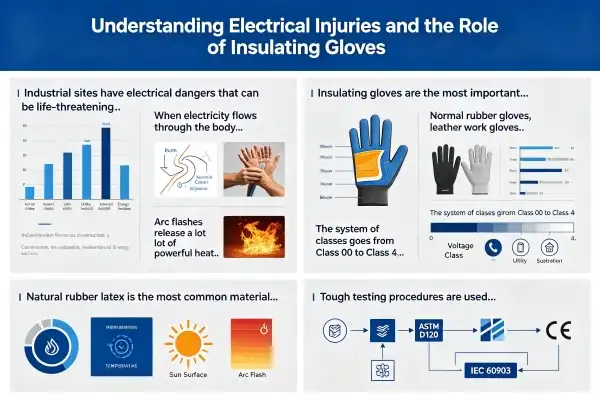
Industrial sites have electrical dangers that can be life-threatening. Thousands of workers get electric shocks, burns, and arc flash injuries every year. Many of them become permanently disabled or die. Most incidents happen in the building, utility, industrial, and energy sectors. These are incidents where people accidentally touch live parts while doing regular maintenance, installation, or emergency repairs.
The Severity of Workplace Electrical Incidents
When electricity flows through the body, it can cause heart death, breathing failure, or strong muscle twitches that make it impossible for workers to let go of electrical equipment. Along the current's path, burns appear on the outside and inside, and the damage is often much worse than the cuts show. Arc flashes release a lot of powerful heat and light energy, reaching temperatures higher than 35,000 degrees Fahrenheit (hotter than the sun's surface) and causing terrible burns in milliseconds.
How Electrical Protective Gloves Function
Insulating gloves are the most important thing that keeps workers safe from electrical dangers. These gloves are made from high-dielectric rubber compounds, which keep the electrical resistance constant across their width. This stops current flow. When an expert wearing the right gloves touches an energised circuit, the shielding properties of the gloves drive the electrical current to look for other ways to get to the worker, keeping them from getting shocked or electrocuted. This safety isn't just for simple touch situations; it also protects against faults and sudden power spikes that can happen in old electrical systems.
Superiority Over Alternative Hand Protection
Normal rubber gloves, leather work gloves, and all-purpose PPE don't have the designed insulation qualities that are needed to protect against electricity. Leather guards are very important because they keep insulating gloves safe from damage like cuts and punctures, but they don't provide any electrical protection. Procurement managers need to know the difference between these two terms. Only insulating gloves that were made and tested to be electrical insulation equipment can really protect you from live wires. Mixing types of protective equipment leads to dangerous misunderstandings about worker safety and makes companies more vulnerable to lawsuits.
Key Types and Standards of Insulating Gloves for Industrial Use
Selecting appropriate electrical protective gloves requires understanding classification systems, material properties, and regulatory compliance frameworks. The industry categorizes these gloves into classes based on maximum use voltage, with each class engineered to meet specific operational requirements.
Voltage Class Systems and Applications
The system of classes goes from Class 00 to Class 4, with each level built for settings with higher power. Class 00 gloves, which can handle up to 500V AC, are used in low-voltage areas like telephones, control circuits, and light industrial repair. These gloves provide enough protection while also being very sensitive to touch, which lets techs work precisely and handle small parts. Class 0 gloves cover up to 1,000V AC and can be used for utility billing, home electrical work, and maintenance on business buildings. Higher classes cover work on the distribution grid, in substations, and in high-voltage industry settings where exposure is more than 1,000 volts.
Material Composition and Performance Characteristics
Natural rubber latex is the most common material used to make insulation gloves because it is very flexible, has a high dielectric strength, and has been used reliably in industry for decades. At PPE MAX, our Class 00 gloves are made from high-quality natural rubber latex. These gloves give workers the flexibility they need to do complicated jobs while still protecting them from electricity. The material doesn't break down when exposed to ozone or UV light, so it can last longer even in harsh weather conditions. Our practical design mindset makes sure that workers' hands don't get tired after long periods of use, which is important for keeping them productive during long maintenance jobs.
Different kinds of materials, like manmade rubber mixtures, have their own perks. In places where petroleum products or industrial acids are found, EPDM formulas offer better chemical protection. Nitrile mixes offer better protection to punctures while still being flexible enough. When choosing materials for the job, you should think about the risks that come with it, like chemical splashes, high temperatures, and motor stress that comes with doing certain tasks.
International Standards Compliance
Tough testing procedures are used to make sure that gloves meet basic performance standards for regulatory compliance. Electrical shielding gloves used in North America, Europe, and most other countries around the world must meet the standards set by ASTM D120 and IEC 60903. These standards require proof testing at voltages that are much higher than the highest use values. For example, our Class 00 gloves are tested for proof at 2,500V, which is five times their working voltage limit. This safety buffer takes into account things like material wear and tear, small flaws, and real-life stressors that happen during normal use.
When something has a CE mark on it, it means that it meets European standards for health, safety, and environmental protection. Products going to be sold in the EU must have this label on them, and they must be checked by a third party to make sure they follow the rules. When buying things for international companies, procurement workers should make sure that sellers provide full approval documents that are good in all operating areas. PPE MAX keeps its ASTM D120, IEC 60903, and CE marking standards up to date. This lets it easily join global supply chains that serve 134 countries.
Selection Criteria: How to Choose the Best Insulating Gloves for Your Business Needs
Effective procurement decisions balance technical specifications against operational realities and budget constraints when selecting insulating gloves. Safety managers and purchasing departments must collaborate to identify insulating glove requirements that match actual workplace conditions while satisfying regulatory obligations.
Voltage Assessment and Task Analysis
Determining appropriate voltage ratings begins with comprehensive electrical hazard assessments. Document maximum voltage levels present in work environments, considering both normal operating conditions and fault scenarios. Include adequate safety margins—selecting gloves rated significantly above expected exposure provides crucial protection against measurement errors, voltage fluctuations, and unexpected circuit conditions. Task-specific requirements influence glove selection beyond voltage considerations. Precision work demands thinner materials and shorter cuff lengths that enhance tactile feedback. Heavy industrial applications benefit from thicker construction and extended cuffs that prevent electrical tracking along the glove surface.
Evaluating Critical Performance Features
Our Class 00 insulating gloves demonstrate how thoughtful engineering addresses real-world operational challenges. Available in sizes 8 through 11, they accommodate diverse workforce hand dimensions, ensuring proper fit across your team. We offer both 11-inch and 14-inch length options—the extended version provides additional forearm protection, valuable when reaching into electrical enclosures or working near multiple energized components. Red and black color choices support organizational color-coding systems that help workers quickly identify voltage ratings in mixed equipment environments. At just 170 grams per pair, these lightweight gloves reduce hand fatigue without compromising protective integrity.
Grip performance affects both safety and productivity. Gloves must maintain a secure hold on tools and components in dry conditions and wet environments alike. Our natural rubber formulation delivers excellent grip characteristics, reducing the likelihood of dropped tools that could create secondary hazards. Dexterity remains paramount—workers need sufficient tactile sensation to manipulate controls, connect conductors, and perform detailed tasks without removing protective equipment.
Supplier Capabilities and Partnership Value
Beyond product specifications, evaluate supplier capabilities that impact long-term procurement success. Manufacturing expertise matters—PPE MAX's heritage extends back to 1956, representing over six decades of continuous improvement in protective equipment design and production. This experience translates into refined quality control processes, consistent product performance, and a deep understanding of customer requirements across diverse industries. Bulk purchasing arrangements deliver cost advantages while ensuring inventory availability for organizations managing large workforces. Our standard packaging of one pair per box and twenty pairs per carton (carton dimensions: 54.5 cm x 35 cm x 42.5 cm, weight: 6.5kg) optimizes logistics efficiency for international shipping and warehouse management.
Customization options accommodate specific organizational needs. Private labeling supports brand consistency for distributors and large enterprises. Custom packaging configurations streamline internal distribution systems. Technical consultation services help procurement teams navigate complex specifications, ensuring glove selections align with both safety requirements and operational constraints. Global shipping capabilities from our Northwest China manufacturing base reach 134 countries, supporting multinational operations with reliable supply chain continuity.
Proper Use, Testing, and Maintenance of Insulating Gloves
Even the highest-quality protective equipment fails when maintenance protocols are neglected. Establishing rigorous inspection, testing, and care procedures preserves glove integrity throughout their service life.
Pre-Use Inspection Protocols
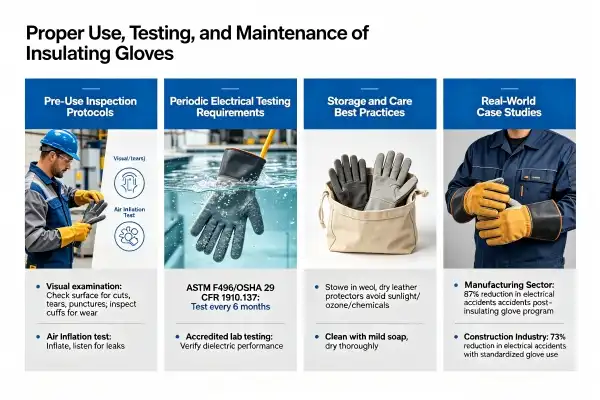
Workers must conduct visual examinations before each use. Check the entire glove surface for cuts, tears, punctures, or embedded foreign objects that compromise insulation. Look for signs of chemical damage, including discoloration, swelling, or texture changes. Examine cuff regions where repeated donning and doffing causes accelerated wear. The air inflation test provides a simple field verification method—inflate the glove and listen for air leaks while applying gentle pressure. Any defect warrants immediate removal from service, regardless of how minor it appears.
Periodic Electrical Testing Requirements
ASTM F496 and OSHA 29 CFR 1910.137 mandate periodic electrical testing at intervals not exceeding six months after gloves enter service. This testing verifies continued dielectric performance through the controlled application of test voltages while the glove is submerged in water. Testing must occur at accredited laboratories equipped with appropriate high-voltage equipment and qualified technicians. Organizations maintaining large glove inventories should establish rotation systems ensuring timely testing without disrupting operational readiness. Maintain detailed records documenting test dates, results, and glove identification to satisfy compliance audits and liability protection requirements.
Storage and Care Best Practices
Proper storage extends glove service life and maintains protective properties. Store gloves in cool, dry locations away from direct sunlight, electrical equipment generating ozone, and chemical exposure. Canvas bags or dedicated storage containers prevent compression and folding that causes cracking in rubber compounds. Never store gloves in toolboxes alongside sharp objects or contaminated tools. Establish clear identification systems marking test dates and voltage classes to prevent accidental use of incorrect gloves. Clean gloves after use with mild soap and water, thoroughly drying before storage to prevent microbial growth and material degradation.
Leather Protector Integration
Always wear leather protector gloves over insulating gloves during actual work. Leather protectors shield the delicate rubber material of insulating gloves from mechanical damage that can occur when handling rough surfaces, sharp edges, or heavy components. This two-layer system maximizes both electrical protection and durability, preventing costly premature glove replacement. Leather protectors also improve grip on oily or wet surfaces, enhancing worker control during critical tasks. Train workers on correct donning procedures—insulating gloves first, followed by leather protectors properly sized to fit over the electrical protective layer without bunching or restricting movement.
Real-World Case Studies: Impact of Insulating Gloves on Preventing Electrical Injuries
Documented case studies demonstrate measurable safety improvements achieved through proper insulating glove implementation. These examples provide procurement justification and highlight best practices applicable across industries.
Manufacturing Sector Safety Enhancement
After having three dangerous shocks in eighteen months, a big car-making plant made a lot of changes to improve electrical safety. As part of the program, all non-certified hand protection was swapped out for certified Class 00 and Class 0 insulated gloves that were matched to the plant's specific voltage exposures. They made pre-use check training required and set up a strict testing plan that runs every six months through a qualified laboratory. Over the next three years, electrical accidents dropped by 87%, and no one got hurt badly enough to need to go to the hospital. Workers said they felt more confident doing electrical repair, and productivity went up as techs didn't hesitate to finish jobs out of safety concern.
Construction Industry Arc Flash Mitigation
A regional electrical contractor that works on business building projects made sure that all of their field teams followed the same rules for protecting gloves. In the past, workers used different kinds of hand protection depending on their own preferences. This made it hard to know what tools were best for each job. For work below 500V, the new program said to wear Class 00 gloves. For work on distribution panels, it said to wear Class 0, and for utility connecting jobs, it said to wear higher classes. Along with thorough training on arc flash dangers and how to take care of gloves, the effort cut electrical accidents by 73% over two years. Insurance rates went down a lot, which covered the costs of the scheme and gave workers better security.
Conclusion
To keep workers from getting seriously hurt by electricity, you need to choose the right tools, follow strict care rules, and train your workers well. Insulating gloves are the first line of defence against electrocution, burns, and arc flashes, which happen every day in the energy, industrial, building, and utility industries. When procurement pros buy approved gloves that meet ASTM D120 and IEC 60903 standards, pair them with leather covers, and test them on a regular basis, they build strong safety systems that save lives and lower an organization's risk of liability. Real-life examples show that good insulation gloves greatly lower the number of electrical injuries that happen and also boost output by making workers more confident and making sure they follow the rules.
FAQ
1. What distinguishes insulating gloves from regular rubber gloves?
Insulating gloves undergo rigorous electrical testing to verify dielectric properties at specific voltage levels, meeting ASTM D120 or IEC 60903 standards. Regular rubber gloves lack these certifications and provide no verified electrical protection, despite superficial similarity. Only use certified insulating gloves for electrical work.
2. How often should we test our insulating gloves?
OSHA and ASTM F496 require electrical testing every six months after gloves enter service. Unused gloves in original packaging may wait twelve months before testing, but the interval begins immediately upon first issue to workers.
3. Can we use Class 00 gloves for voltages above 500V AC?
No. Maximum use voltage represents an absolute safety limit—exceeding this rating significantly increases electrocution risk through dielectric breakdown. Voltage exposures above 500V AC require Class 0 or higher gloves matched to actual circuit voltages.
4. Do leather protectors serve an essential function?
Leather protectors are mandatory, not optional. They shield delicate rubber insulation from cuts, abrasions, and punctures that compromise electrical protection. Always wear properly fitted leather protectors over insulating gloves during work activities.
Partner with a Trusted Insulating Gloves Manufacturer for Superior Electrical Protection
Protecting your workforce requires partnering with proven suppliers who understand both product engineering and operational realities. PPE MAX brings over 65 years of manufacturing expertise to organizations seeking reliable electrical safety solutions. Our Class 00 insulating gloves combine superior dielectric performance with practical features like ergonomic fit, excellent grip in wet and dry conditions, and lightweight construction that reduces fatigue. We maintain rigorous quality control aligned with ASTM D120 and IEC 60903 standards for insulating gloves, ensuring every pair delivers consistent protection across global deployments spanning 134 countries. Bulk purchasing options provide cost advantages for organizations managing large safety equipment inventories, while our international shipping capabilities ensure reliable supply chain continuity. Contact our technical team at marketing@ppemax.com to discuss your specific voltage requirements, workforce sizing needs, and customization options that optimize both safety outcomes and procurement efficiency.
References
1. National Institute for Occupational Safety and Health (NIOSH). "Electrical Safety: Safety and Health for Electrical Trades Student Manual." Department of Health and Human Services, Centers for Disease Control and Prevention, 2009.
2. American Society for Testing and Materials. "ASTM D120-20: Standard Specification for Rubber Insulating Gloves." West Conshohocken, PA: ASTM International, 2020.
3. Institute of Electrical and Electronics Engineers. "IEEE Std 1584-2018: IEEE Guide for Performing Arc-Flash Hazard Calculations." New York: IEEE Standards Association, 2018.
4. Occupational Safety and Health Administration. "OSHA 29 CFR 1910.137: Electrical Protective Devices." U.S. Department of Labor, Washington, DC, 2007.
5. International Electrotechnical Commission. "IEC 60903:2002+AMD1:2020: Live Working - Gloves of Insulating Material." Geneva: International Electrotechnical Commission, 2020.
6. National Fire Protection Association. "NFPA 70E-2021: Standard for Electrical Safety in the Workplace." Quincy, MA: National Fire Protection Association, 2021.
Learn about our latest products and discounts through SMS or email