- English
- French
- German
- Portuguese
- Spanish
- Russian
- Japanese
- Korean
- Arabic
- Greek
- German
- Turkish
- Italian
- Danish
- Romanian
- Indonesian
- Czech
- Afrikaans
- Swedish
- Polish
- Basque
- Catalan
- Esperanto
- Hindi
- Lao
- Albanian
- Amharic
- Armenian
- Azerbaijani
- Belarusian
- Bengali
- Bosnian
- Bulgarian
- Cebuano
- Chichewa
- Corsican
- Croatian
- Dutch
- Estonian
- Filipino
- Finnish
- Frisian
- Galician
- Georgian
- Gujarati
- Haitian
- Hausa
- Hawaiian
- Hebrew
- Hmong
- Hungarian
- Icelandic
- Igbo
- Javanese
- Kannada
- Kazakh
- Khmer
- Kurdish
- Kyrgyz
- Latin
- Latvian
- Lithuanian
- Luxembou..
- Macedonian
- Malagasy
- Malay
- Malayalam
- Maltese
- Maori
- Marathi
- Mongolian
- Burmese
- Nepali
- Norwegian
- Pashto
- Persian
- Punjabi
- Serbian
- Sesotho
- Sinhala
- Slovak
- Slovenian
- Somali
- Samoan
- Scots Gaelic
- Shona
- Sindhi
- Sundanese
- Swahili
- Tajik
- Tamil
- Telugu
- Thai
- Ukrainian
- Urdu
- Uzbek
- Vietnamese
- Welsh
- Xhosa
- Yiddish
- Yoruba
- Zulu
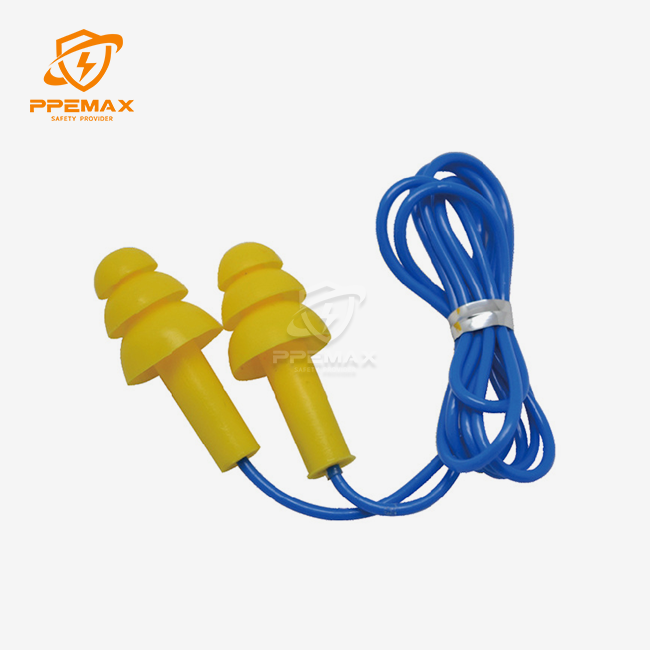
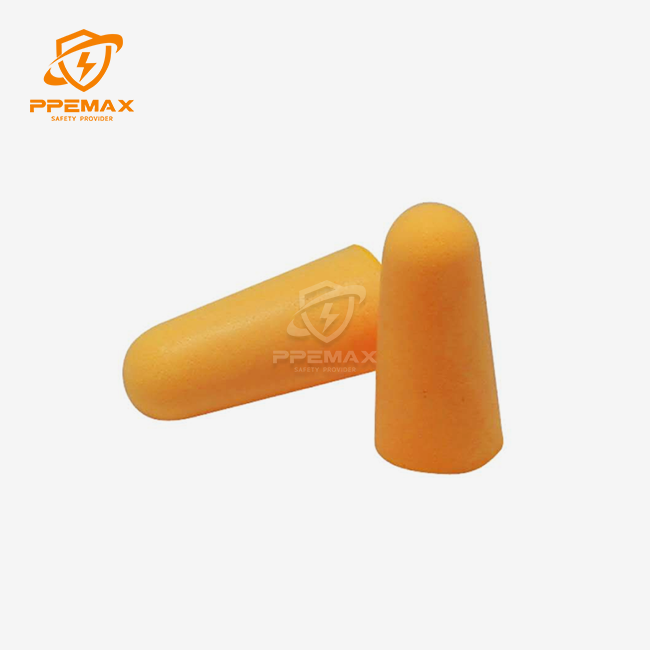
Disposable PU Foam High Fidelity Noise Reduction Earplugs
Color and size can be customized
CE certification
Disposable PU Foam High Fidelity Noise Reduction Earplugs — Single-Use Hearing Protection with Clear Sound Clarity
Xi'An PPE MAX Co., Ltd has built hearing protection for more than six decades. Our Disposable PU Foam High Fidelity Noise Reduction Earplugs are one example. Each plug is molded from viscoelastic polyurethane foam. At 21°C, that foam needs 30–60 seconds to rebound. Lab tests show NRR 30–33 dB (ANSI S3.19) and SNR 34–37 dB (EN 352-2). The attenuation curve stays flat, so noise falls by about the same amount at every frequency. Speech still gets through clearly. Pressure from expansion stays below 1.0 psi. Long wear does not leave the ear canal sore.
Xi'An PPE MAX Co., Ltd: This Product Manufacturer & Supplier
More than 60 years of workplace hearing protection stand behind PPE MAX. The whole product line follows one rule that works in practice. A worker must get real noise reduction. That worker also needs to catch verbal instructions and hear when a machine starts running rough.
Before any earplug batch ships, it goes through checks. Staff look at whether rebound time stays consistent. Next comes a visual and tactile inspection. Acoustic attenuation testing wraps things up.

What Are This Product?
Every sound gets blocked the same way with standard foam earplugs. The result is the "occlusion effect". Speech comes through muffled. Workers also feel shut off from the things going on around them. In places where people have to talk to one another, that becomes a genuine safety issue.
Controlled cellular density and structural geometry let these earplugs fix that problem. The attenuation curve turns out flatter than with foam. Sound drops off evenly at low, mid, and high frequencies. Nothing piles up at one end of the spectrum. Effective hearing protection is what workers get. Speech stays clear, and so does awareness of the surroundings.
The outer skin is smooth and resists soil, so dirt has a harder time building up on it. That acoustic seal still holds. Steady performance across shifts rests on that seal.

Standard Specifications
| Parameter | Value |
|---|---|
| Material | Viscoelastic polyurethane (PU) foam |
| Rebound Time | 30–60 seconds at 21°C |
| Expansion Pressure | < 1.0 psi |
| NRR (ANSI S3.19) | 30–33 dB |
| SNR (EN 352-2) | 34–37 dB |
| Compliance Standards | ANSI S3.19, EN 352-2, AS/NZS 1270 |
| Surface | Smooth, soil-resistant outer skin |
| Usage Type | Single-use / Disposable |
| Customization | Color and size (available for bulk orders) |
| Shelf Life | 3–5 years (stored away from UV and humidity) |

Key Features
Flat Attenuation Curve
Noise reduction is distributed evenly across the full frequency spectrum. Low-frequency and high-frequency blocking variance stays small — that is the technical basis for the high-fidelity performance claim.
Slow-Recovery PU Foam
The plug takes 30–60 seconds to rebound at 21°C. That is enough time to push it all the way in before it swells. The acoustic seal holds every time.
Low Expansion Pressure
Pressure from expansion remains below 1.0 psi. Because of that, discomfort stays low. Wearing these earplugs for a full shift will not leave the ear canal worn out.
Soil-Resistant Disposable PU Foam High Fidelity Noise Reduction Earplugs Smooth Outer Skin
Dirt is slow to build up on this surface. In industrial settings, that matters a lot. Hygiene rules there affect worker health and how well the earplugs perform.
Single-Use Design
A single use is all you get from each earplug, then it goes in the bin. Sharing is off the table, so cross-contamination can't happen. Acoustic performance stays intact as well. Nothing has worn the plug down beforehand, and no bad cleaning job has touched it.

Additional Advantages
- Speech stays clear. While the protection is on, workers can still hear spoken commands and radio calls
- It works alongside communication earmuffs. In very noisy spots you can set up double protection
- The PU composite does not pose a toxic risk. RoHS and REACH screening checks it, which means heavy metals and banned phthalates are kept out
- Made-to-order colors and sizes are available to B2B clients. A branded program or the rules of a specific site can then get PPE that fits.

Typical Applications for Disposable PU Foam High Fidelity Noise Reduction Earplugs
Precision Manufacturing and Aerospace Maintenance
CNC machining floors and aircraft maintenance hangars get loud. Decibel levels run high there, and the noise comes in bursts. Workers still have to catch machine calibration signals. Voice safety instructions have to reach them too. A flat attenuation curve protects their hearing and keeps them aware of what goes on around them.
Motorsports and Automotive Testing
Trackside work and engine test duty both ask a lot of your ears. A mechanic has to pick a sound out of the noise and notice when something is off. Ordinary foam plugs blur that detail. These earplugs cut the noise by a set amount. Over a long shift, exposure drops. What you keep is the frequency detail that fault finding depends on.
Staffing Events and Running Big Venues
At big venues, security teams and production crew take steady high-volume noise all day. You can wear these earplugs under communication earmuffs. Radio talk stays clear, and the risk of tinnitus from long exposure goes down.

Why Work With PPE MAX?
PPE MAX has been producing PPE since 1956. Our quality control process covers rebound time batch testing, visual and tactile inspection, acoustic attenuation verification, and chemical compliance screening. Color and size customization are available for bulk B2B orders, along with custom packaging and labeling options.
We participate in international safety and occupational health exhibitions and welcome customer visits to our facility in Xi'An for direct review of our production and quality processes.


Certifications and Compliance
- CE Certification (EN 352-2)
- ANSI S3.19 (US standard)
- AS/NZS 1270 (the standard that applies in Australia and New Zealand)
- RoHS and REACH: the testing looks at heavy metals and at phthalates that are banned

Packaging
Every product leaves us in its original packaging. That packaging is built to block UV light and keep moisture out of Disposable PU Foam High Fidelity Noise Reduction Earplugs, since both break PU foam down over time. Store it right and the 3–5 year shelf life holds. So does the slow-recovery compression cycle, right up to the moment the product is used.
Bulk packaging and custom labeling are available for B2B clients.

FAQ
Q: Can these earplugs be washed and reused?
A: No. The porous PU foam soaks up moisture and earwax. Wash it, and the cellular structure breaks down. That kills the slow-recovery property. Hygiene and acoustic performance are the reasons these are strictly single-use.
Q: How does temperature affect performance?
A: Temperature affects PU foam. Out in the cold, the foam may feel stiffer at the start. Body heat softens it quickly, though. Rebound stays consistent through normal shifts in ambient temperature, because the formulation is built for that.
Q: How does the flat attenuation profile differ from silicone filter earplugs?
A: This design achieves flat attenuation through controlled foam porosity and cellular density rather than a physical filter duct. The result is a smaller variance between low-frequency and high-frequency blocking compared to standard foam plugs. The difference is visible in the attenuation data chart across tested frequency bands.
Q: Why do some users find the earplugs come loose?
A: Insertion is usually what causes this. Try the Roll, Pull, Hold method. Roll the plug into a tight cylinder. Pull the outer ear up and back so the canal straightens out. Then insert the plug deeply and hold it there until it has fully expanded. Put it in too shallow and the effective NRR drops a lot.
Q: What is the shelf life?
A: Expect 3–5 years, provided the item stays in its original packaging. Humidity should stay low and UV light should not reach it. Sunlight breaks the PU material down. Once that happens, the compression-recovery cycle stops working, and a correct fit depends on that cycle.
Q: Can bulk orders be customized?
A: Yes. Color and size are yours to pick on B2B bulk orders. Packaging and labeling we take care of too. Send us what you need and we will walk through the details with you.
Contact Us
Interested in sourcing Disposable PU Foam High Fidelity Noise Reduction Earplugs? Send your inquiry to bettybing@ppemax.com and our team will follow up.
Learn about our latest products and discounts through SMS or email